Career Restart
Restarting Your Career After a Gap: A Practical Plan That Actually Ends in a Job
Sony Aggrawal · Talent Partner · · 13 min read
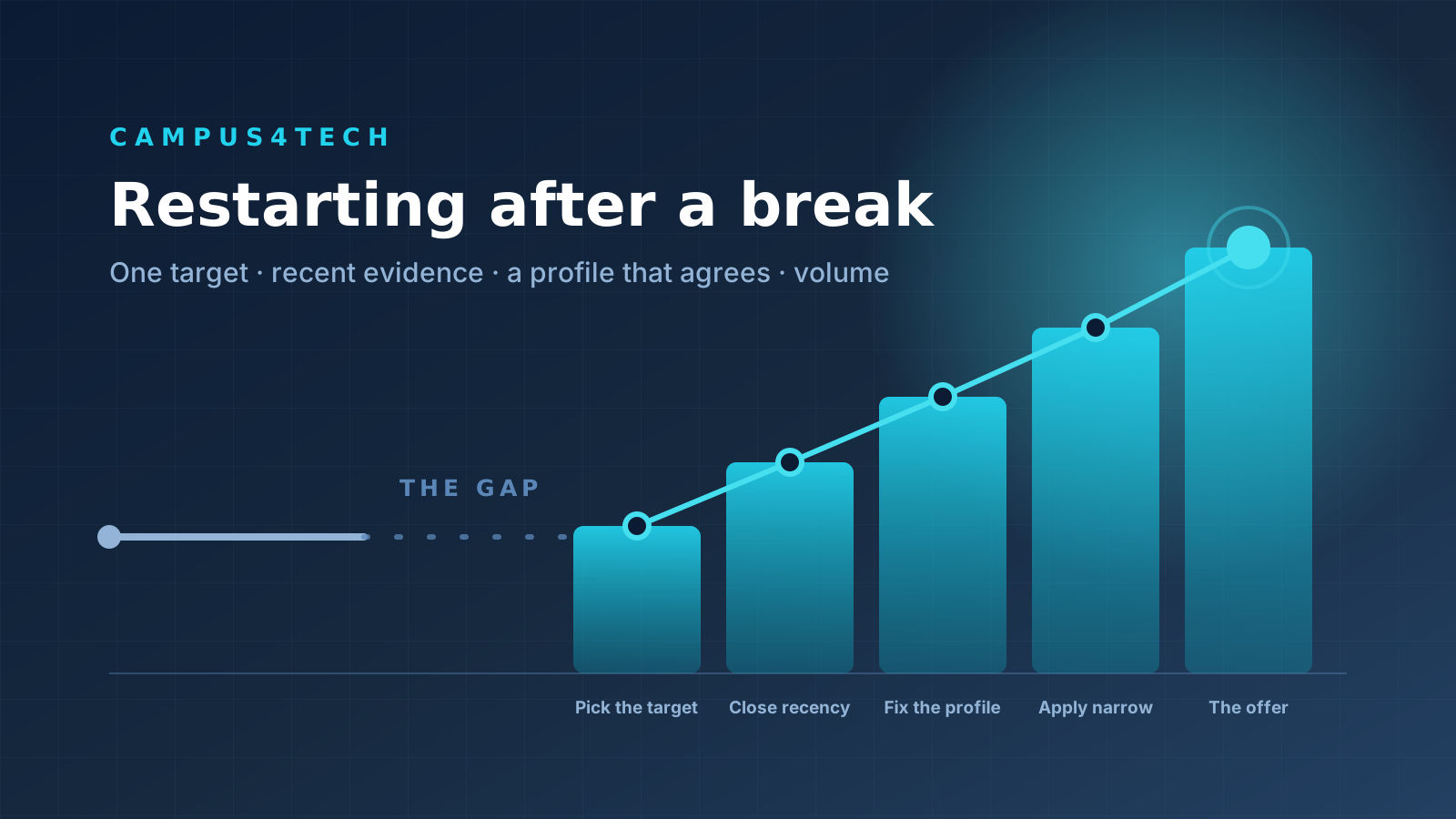
There is a lot of advice about how to answer the gap question in an interview. There is very little about the harder problem underneath it: how to actually get from “I have been out of work for fourteen months” to “I start on the third of next month.”
Those are different problems. The first is sixty seconds of a forty-five minute conversation. The second is a project that takes most people three to six months and fails for reasons that have nothing to do with how well they explain themselves.
I work with candidates through applications, offers and the first weeks in a new role, and the pattern in restarts that stall is remarkably consistent. It is almost never the gap. It is the absence of a sequence. People do all the right activities, in the wrong order, at the wrong intensity, and then conclude the market has rejected them.
Here is the sequence that works.
Phase 0: Decide the target role before you do anything else
The most expensive mistake in a restart is staying open to everything.
It feels like the safe choice. More options, more chances. In practice, a candidate targeting “anything in data or BA or project coordination” produces a resume that argues for nothing, cannot be searched for in any recruiter’s database, and cannot be prepared for. Every hour you spend is spread across three job searches instead of concentrated in one.
Pick one primary target and, at most, one adjacent fallback. Write it down as a specific line:
Target: Oracle HCM Cloud Functional Consultant, Core HR and Absence Management. US contract or full-time, remote or hybrid. Adjacent: HRIS Analyst roles at mid-size companies already running Oracle HCM.
If you cannot write that sentence, that is the first piece of work, not the applications. It is also the first thing we do with anyone who comes to us for job support, before a single application goes out. Look at ten to fifteen live job postings you would genuinely accept, and find the role title that appears most often across the ones you are qualified for today. Not the one you want in three years. The one that gets you back in.
A restart needs one job, not the right job. The second role after a break is dramatically easier to get than the first one, and you will be choosing from a much stronger position twelve months from now.
Phase 1: Close the recency gap, not the skills gap (weeks 1 to 4)
Here is what hiring managers are actually worried about when they see a break. Not that you have forgotten how to do the work. It is that you have been away from the current version of it. Tools move. Cloud releases ship twice a year. Ways of working change.
So the goal of this phase is evidence of recency, and it needs to be dated and verifiable. In rough order of how much weight it carries:
- Paid work of any size. A three-month contract, a short freelance engagement, a part-time role. This is worth more than everything below it combined, and it is the fastest thing you can do to end the gap on paper, because it ends the gap on paper.
- A real project with an output someone can look at. Not a tutorial you followed. A dashboard, a repository, a configured sandbox instance, a documented process redesign for a small business or a nonprofit.
- A current certification. Useful, and worth doing, but understand what it does: it proves you studied, not that you delivered. It supports a profile; it does not carry one.
- Volunteering in the function. Managing a nonprofit’s payroll, running their reporting, coordinating a project. It is real work and it is dated.
Put side by side, the trade-off is clear enough to decide in an afternoon:
| Evidence | Weight with a hiring manager | Time to get it | What it proves |
|---|---|---|---|
| Short paid contract or freelance work | Highest | 2 to 8 weeks to land | You were trusted with real work, recently |
| A project with a visible output | High | 2 to 4 weeks | You can still do the work, and you finished something |
| Current certification | Medium | 3 to 6 weeks | You studied and you are current on the release |
| Volunteering in your function | Medium | 1 to 3 weeks to start | Real, dated responsibility |
| Another certification on top of the first | Very low | Weeks you cannot afford | Only that you are still preparing |
Give this phase four weeks, and cap it there. This is where restarts quietly die. The candidate starts a certification, then another, then a specialization track, and eight months disappear inside a state of getting ready. There is no level of preparation that makes a job search comfortable. Do one credible thing, then move.
Phase 2: Rebuild the profile so the break is a line, not a hole (week 4)
Two documents matter: your resume and your LinkedIn profile. They must tell the same story with the same dates.
On the resume, the break gets its own entry in the work history, in chronological position, exactly like a job:
Career Break, March 2025 to June 2026 Relocation and family care. Completed Oracle HCM Cloud certification; delivered a six-week freelance absence-management configuration for a 40-employee manufacturing client.
One line of reason, one line of evidence. No apology, no detail about health or family circumstances beyond the word itself. An unexplained hole invites the worst assumption a stranger can make; a labeled break closes the question before it is asked.
Load the top third of the page with current relevance. Above the work history, a short summary that states the target role and the recency work in the same breath:
Oracle HCM Cloud functional consultant, six years across Core HR and Absence Management. Returned to the market in 2026 following a career break, with current R13.24 certification and a recent configuration engagement.
On LinkedIn, set the headline to the target role, not “Seeking opportunities.” Recruiters search by role title, and “Open to work” is not a role title. Add the recency work as a real position entry so your profile shows activity in the current year. Turn on the recruiter-visible open-to-work setting, which is different from the green photo frame and is only seen by recruiters.
Make the three sources agree. Resume, LinkedIn, and any application form must show identical dates. Recruiters do check, and a mismatch reads as concealment even when it is a typo.
If you would rather have someone do this pass with you, send us your resume and we will tell you what a recruiter sees in the first six seconds.
Phase 3: Apply with volume discipline (weeks 5 onward)
This is where the actual work is, and where most people badly misjudge the intensity required.
Target ten to fifteen well-matched applications a week. Not fifty. At fifty you are not reading the postings, and it shows. Not three. At three you are waiting on outcomes you do not control. Applications where you meet most of the requirements, applied to within the first few days of posting, in the same words the posting uses.
Track everything in one place. Company, role, date applied, source, recruiter name, status. This is not administration for its own sake. When a recruiter calls about a role you were already submitted for by someone else, a duplicate submission can get you removed from consideration entirely, and you can only avoid that if you know.
Spend a third of your time on people, not portals. Former colleagues, former managers, two or three recruiters who work your specific skill area. A short, specific message beats a broad one:
“Hi Priya, I worked with you on the Riverside implementation in 2024. I have just come back to the market after a career break and I am looking at Oracle HCM functional roles, contract or permanent. If anything crosses your desk that fits, I would appreciate you keeping me in mind. Resume attached.”
That message asks for one thing, gives context, and takes ten seconds to read.
Follow up once, specifically, five business days after a screening call. Then leave it. Repeated chasing costs goodwill you will need later.
Expect a slow first three weeks. The pipeline you build in week five produces interviews in week eight. Almost everyone who quits, quits during that lag.
Phase 4: The interviews, where the gap is the smallest thing in the room
By this stage the gap is largely handled. It comes up once, you answer it in three sentences, and the conversation moves to whether you can do the work. That question, can you do the work, is what you should be preparing for, and it is where returning candidates under-prepare because they have spent all their anxiety on the gap.
Rehearse out loud, not in your head. Six to eight scenario answers from your actual experience, spoken to another person who will tell you when you sound tentative. After a break, the most common feedback from clients is not “not technical enough.” It is “seemed unsure.” That is a rehearsal problem, and it is fixable in a week.
One more thing: apply for roles at your previous level. Returning candidates routinely aim a level below out of caution, and it backfires. It reads as a mismatch, and interviewers ask why you are applying down.
Phase 5: The offer, and the ninety days after it
Two honest points about offers after a break.
The first role back may pay less than your last one did. Sometimes noticeably. This is worth accepting for a defined period, because the market prices recency and you are buying it. What matters is that the role is genuinely at your level in scope and title. A temporary discount on rate is recoverable in twelve months, a step down in title takes longer to undo.
The restart is not finished when you sign. It is finished somewhere around day ninety. People coming back after a break tend to arrive determined to prove they have not lost anything, and either overwork quietly or avoid asking questions that would make them look rusty. Both go badly. Ask more questions in the first three weeks, not fewer. New joiners are expected to, and the window closes.
The four traps worth naming
- Waiting until you feel ready. You will not. Set a date and start applying against a target you can defend today.
- The endless-course loop. One credential, then move. A second certification with no applications behind it extends the gap you are trying to close.
- Hiding the break. It surfaces at background check, and by then it is a credibility problem rather than a scheduling one.
- Going silent. Recruiters drop candidates who do not respond, and they remember the ones who do.
What the first twelve weeks actually look like
Timelines calm people down, so here is a realistic one. It assumes you are searching seriously, not around a full-time job.
| Weeks | What you are doing | What “on track” looks like |
|---|---|---|
| 1 | Choose the target role and the adjacent fallback | You can write the target in one sentence |
| 1 to 4 | Get one piece of dated, recent evidence | Something with a date in the current year |
| 4 | Rebuild resume and LinkedIn; make the dates agree | Three sources, identical dates |
| 5 to 8 | Apply 10 to 15 a week; reconnect with 2 to 3 recruiters | Screening calls starting, few interviews yet |
| 8 to 12 | Client interviews; rehearse out loud weekly | Interviews converting, feedback getting specific |
| 12+ | Offers, negotiation, notice | An offer at your level, rate possibly below your last |
The quiet stretch is weeks five to eight. It is not a sign the plan failed. It is the plan working at its normal speed.
Your restart checklist
Print this. Tick it in order. Each line only works once the one above it is done.
- I can write my target role in one sentence, with the market and contract type
- I have looked at 10 to 15 live postings I would genuinely accept
- I have one piece of dated evidence from the current year
- My resume shows the break as a labeled entry with a reason and evidence
- My summary names the target role in the first two lines
- My LinkedIn headline is the role title, not “Seeking opportunities”
- Resume, LinkedIn and application forms show identical dates
- I am tracking every application in one place with the recruiter’s name
- I am sending 10 to 15 matched applications a week
- I have contacted 2 to 3 recruiters who work my specific skill area
- I have rehearsed my gap answer out loud, to another person
- I have six to eight scenario answers ready from real experience
- I am applying at my previous level, not one below
Frequently asked questions
How do I restart my career after a 5-year gap?
Work in this order. Pick one target role you could be hired into today. Spend up to four weeks getting one piece of recent, dated evidence, ideally short paid work. Rebuild your resume and LinkedIn so the break is a labeled line with matching dates. Then apply to ten to fifteen well-matched roles a week. Expect three to six months.
A five-year gap changes the emphasis, not the sequence. The recency evidence matters more, and the case for taking a short contract as the way back in gets stronger. What does not change is that applications have to start before you feel ready.
Will companies reject me because of an employment gap?
Most will not reject you for the gap itself. Recruiters see breaks constantly: redundancy, relocation, caring, health, visas. What gets you rejected is an unexplained hole, dates that disagree across your resume and LinkedIn, or no evidence of recent activity. A labeled break with one line of context closes the question before it is asked.
Some employers do screen harder than others, and you will not know which. That is an argument for volume, not for despair.
Can I get a job without recent experience?
Yes, but you need something dated in the current year. Short paid work carries the most weight, then a real project with an output someone can look at, then a current certification, then volunteering in your function. Four weeks is enough to get one of these. Do one and start applying. Do not stack certifications.
Should I mention my career break on LinkedIn?
Yes. Add it as a Career Break entry so your timeline has no unexplained hole, and set your headline to the target role rather than “Seeking opportunities”, because recruiters search by role title. Turn on the recruiter-visible open-to-work setting, which is separate from the green photo frame and is only seen by recruiters.
How long does it take to get a job after a career break?
Plan for three to six months from the day you start applying seriously, not from the day you decide to return. The first three weeks are usually quiet by design. The applications you send in week five produce interviews around week eight. Most people who give up, give up inside that lag.
Can experienced candidates get job support without training?
Yes. Campus4tech offers standalone job support with no training course attached, which is what most experienced candidates and career returners need. That covers choosing the target role, rebuilding the profile, managing applications and submissions, and interview preparation, continuing until you are placed and after you join.
Summary
A restart is not a persuasion problem. It is a sequencing problem: one target, one piece of recent evidence, a profile that agrees with itself, and enough weekly volume to make the numbers work. Do those four things in that order and the gap stops being the subject of the conversation.
If you take one thing from this: the first role back is not the destination. It is the thing that makes every subsequent role easy to get. Optimize for getting back in, not for getting back in perfectly.
This is the situation our job support without a training course is built for: choosing the target role, rebuilding the profile, managing applications and submissions, and preparing for the client interview, with us staying on it until you are placed and after you join. For experienced candidates coming back from a break, that support is available on its own, with no training course attached. If you want to talk it through first, the career restart form takes about three minutes and someone will come back to you.
Written by
Sony Aggrawal
Talent Partner
Supports candidates through applications, offers and onboarding into new roles.