Getting Hired
How to Get a Job in Dubai in 2026: The 90 Day Plan for Senior Roles
SK Chauhan · Founder · · 19 min read
The message arrives most weeks, and it is almost always worded the same way. Two hundred applications sent. Three replies, all rejections. Can somebody look at my CV.
We usually do look. The CV is usually fine.
That is the awkward part of the answer, and it is the part people are least ready to hear. Most stalled searches in this region are not stalled because of a document. They are stalled because there is no sequence. The candidate has been doing one activity, applying, for twelve weeks, and expecting a result that activity has never produced at volume for anybody.
So this is the plan we give instead of a CV rewrite.
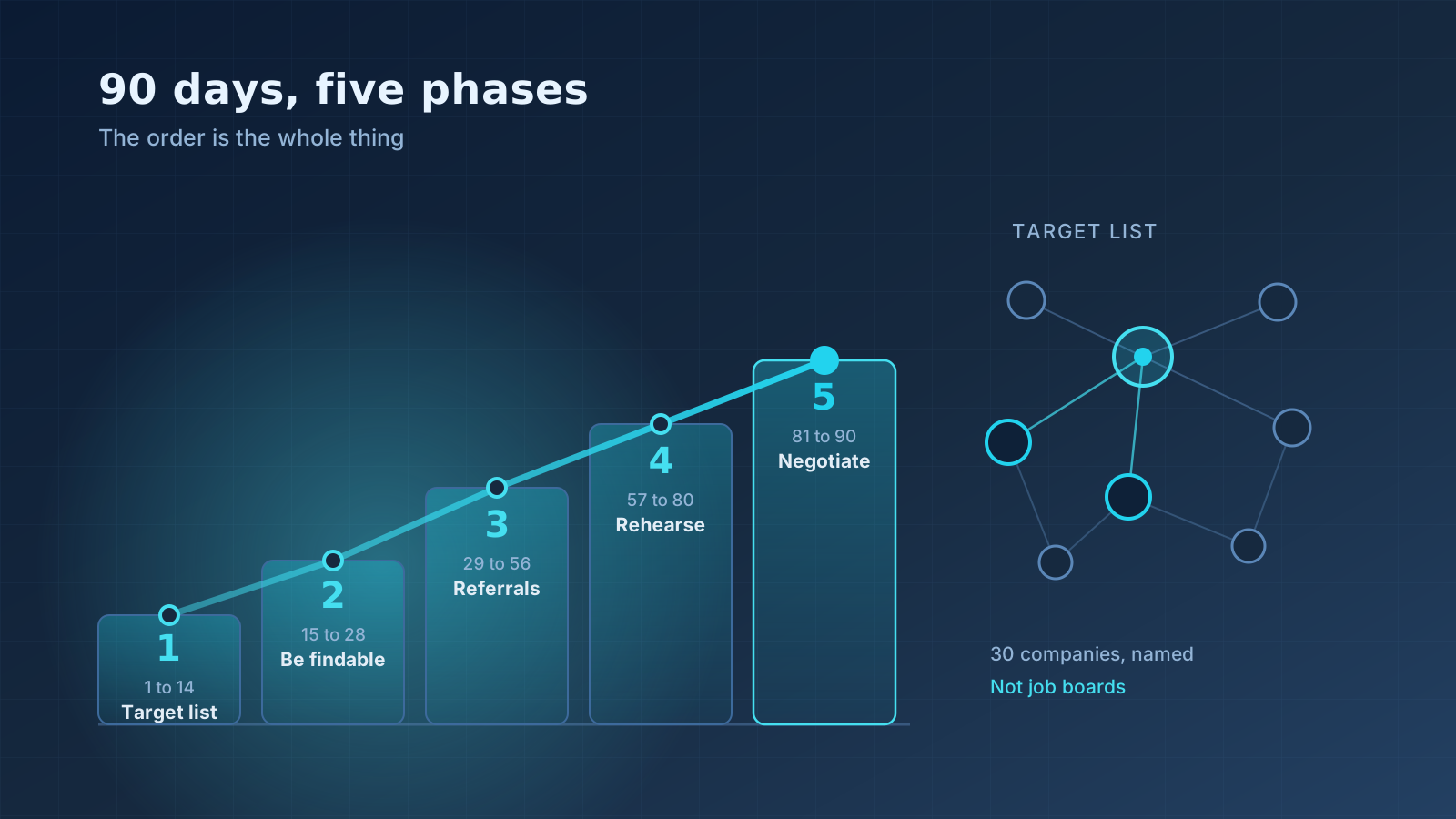
Getting a senior job in Dubai in 2026 takes five phases run in order across ninety days. Build a target list of thirty companies in the first fortnight. Make yourself findable in recruiter searches by day 28. Build a referral pipeline through day 56. Rehearse your interview answers by day 80. Negotiate the whole package, not the salary, in the final ten days.
Ninety days is genuinely enough to land a senior role here. It stops being enough the moment you spend eighty of them on one phase.
Is it hard to get a job in Dubai right now?
It is more selective than it was, and it is not closed. A large share of UAE employers are still adding headcount, but the briefs are tighter, the shortlists are shorter and the tolerance for a near miss has dropped. Hiring did not stop in this market. It became specific. That distinction is the whole reason sequencing matters more in 2026 than it did two years ago.
A loose search survives a hot market. It cannot survive a selective one. When employers are hiring broadly, an unfocused candidate still gets pulled through on availability. When employers are hiring narrowly, the same candidate becomes invisible, and reads the silence as rejection when it is actually absence.
Everything below is designed for a selective market.
Days 1 to 14: build a target list of thirty companies
Ask most candidates in the Gulf what they are looking for and you get a paragraph. Open to opportunities across the region. Flexible on sector. Happy to consider adjacent roles. Keen to hear what is out there.
It is meant to read as available. It lands as unfocused, and a recruiter cannot act on it. Nobody can introduce you to everyone.
These first two weeks produce exactly one output: a list of about thirty companies you would say yes to in week one. Not a hundred. Not a sector. Thirty named organisations.
Thirty is the right number for a reason. It is small enough that you can research each one properly and speak about them credibly, and large enough that eight rejections do not end your search.
How to build the list
Work through these sources in order and write down every company that fits, then cut back to thirty.
| Source | What you are looking for |
|---|---|
| Job boards, filtered to your function and the last 30 days | Who is hiring right now for roles at or just above your level |
| Company career pages in your sector | Employers who post directly and never reach the boards |
| Free zone directories such as DIFC, DMCC and JAFZA | Regional headquarters clusters in finance, commodities, logistics and tech |
| Trade press and regional business news | Funding rounds, new market entries and contract wins, all of which precede hiring |
| Your own CV | Former clients, suppliers, competitors and partners, where you already have credibility |
| LinkedIn, filtered by company and location | Which of your existing connections already sit inside these organisations |
Then apply one test. Go back through the list and delete anyone you would hesitate about on a Sunday morning. Whatever survives that is your genuine list, and the hesitation you just removed would have shown up in an interview anyway.
For each of the thirty, find two names before you close the file: the person who would be your manager, and one person at roughly your level in the same team. You are not contacting them yet. You will need them on day 29, and finding sixty names is a two evening job that becomes a two week job if you leave it until you need it.
You are finished with this phase when you can name your thirty companies without opening the document.
If you want a sense of what is actually live in the market while you build the list, our current job openings are a reasonable place to calibrate which titles are moving and which are not.
Days 15 to 28: make yourself findable in a recruiter search
This is the phase almost everyone believes they have already done, because they updated a headline at some point last year.
Here is the mechanism people miss. Recruiters in this region do not sit and read inbound applications in order of arrival. They run searches. Inside their applicant tracking system, across their own database of past candidates, and on LinkedIn. Your keywords do not decide whether you impress anybody. They decide whether you appear in the list at all.
A CV written in the language of duties will not surface. A CV written in the language of the role will.
We open CVs every week from genuinely strong people that read like the job description of a job they already held. Responsible for. Oversaw. Involved in. Supported the delivery of. Nobody searches for those words, so those CVs are not rejected. They are absent.
The rebuild, in practical terms
Pull five job adverts from your list of thirty. Highlight every tool, system, standard and skill that appears in at least three of them. Those terms belong in your CV, written in your own sentences, each one attached to an outcome you could defend for two minutes under questioning.
| Before | After |
|---|---|
| Responsible for the regional finance function | Ran finance for a nine country GCC and Levant business, closing monthly consolidation in five working days across three currencies |
| Oversaw supply chain operations | Rebuilt the GCC distribution network across 4 warehouses, cutting order to delivery from 6 days to 48 hours |
| Involved in digital transformation | Led the ERP migration for the UAE entity, 340 users live in 11 months, delivered inside budget |
| Supported business development in the region | Opened Saudi and Qatar for a UAE headquartered SaaS business, taking regional revenue from AED 4m to AED 11m in two years |
| Managed a team | Built and led a team of 14 across Dubai and Riyadh, with two internal promotions in eighteen months |
The right hand column does two jobs at once. It carries the searchable terms, and it proves the claim in the same sentence. That is the whole trick, and it is not a template question.
Here are terms worth carrying for three common senior Gulf profiles, where they are true of you.
| Target role | Terms recruiters here actually search |
|---|---|
| Finance Director | IFRS, consolidation, FP&A, statutory audit, VAT, corporate tax, treasury, GCC multi entity, ERP implementation, board reporting |
| Head of Supply Chain | S&OP, demand planning, 3PL management, customs clearance, free zone logistics, cold chain, WMS, inventory turns, GCC distribution |
| Commercial or Sales Director | GCC market entry, channel partners, distributor management, government and semi government clients, tender submissions, P&L ownership, key account growth |
Two more things belong in this fortnight. Set your LinkedIn location to the city you are targeting rather than the one you are sitting in, if you are genuinely willing to move. And turn the recruiter facing Open to Work setting on, which is visible only to people using LinkedIn Recruiter and puts you inside a filter they use daily.
Then be visible. Two useful posts a week about your function, and twenty minutes a day in the comment sections of people who work at your thirty companies. This is not personal branding. It is the reason your name looks familiar when somebody opens your profile after a conversation.
If you want an outside read on how your CV parses and what a recruiter sees in the first four seconds, you can send your CV to our team for a review.
You are finished with this phase when a recruiter searching your job title and your city would find you on the first page of results.
Days 29 to 56: build a referral pipeline
This is the phase almost nobody runs, and it is the longest one on purpose.
You have heard the claim that most jobs are never advertised. That figure gets repeated constantly and traces back to nothing you can check, so we will not use it.
Use this instead. Ashby, an applicant tracking system vendor, published an analysis of more than 38 million applications across roughly 93,000 job postings between January 2021 and December 2024. In that data, referrals made up around one per cent of all applications submitted, yet about 40 per cent of referred candidates progressed from application to interview. Inbound applications were the overwhelming majority of everything sent, and their conversion to offer had fallen to roughly two in a thousand.
Sit with the size of that gap. The channel almost nobody uses converts at around four in ten to interview. The channel everybody floods converts at around two in a thousand to offer.
That is global data drawn from applicant tracking systems rather than a UAE specific study, and we would want regional numbers before treating the exact percentages as a Gulf benchmark. But the direction matches what we see from the hiring side here every week, and if anything relationships carry more weight in this market than that data suggests, not less.
How to actually run it
Twenty five second degree contacts a week, for four weeks. Second degree specifically, because a shared connection is the thing that makes the message get opened.
Lead with something useful. Do not open with a request. Nobody refers a stranger whose first message was a favour.
Opening message, second degree contact
Hello Fatima, we are both connected to Rashid at Emrill so your name came up. I have spent the last six years running GCC supply chain for an FMCG distributor and I am mapping how the market is handling the new customs process at Jebel Ali. How has your team found it in practice? Genuinely curious rather than selling anything.
Opening message, former colleague you have lost touch with
Hello Sanjay, it has been a while since the Oracle rollout at Al Futtaim. I saw you moved across to Chalhoub last year, congratulations. I am looking at my next move in the region and I am trying to understand which businesses here are actually investing in the finance function rather than trimming it. What is your read from where you sit?
The ask, only after two or three exchanges
Thanks, that was genuinely useful. One thing, and please say no if it is awkward. I saw the Financial Controller role posted on your careers page last week and I think it lines up well with the GCC consolidation work I did at my last business. Would you be comfortable passing my name to whoever owns that hire? Happy to send you a short summary you can forward rather than the full CV.
Notice the shape of the third message. It names the specific role, gives one line of justification, offers an easy exit, and reduces the effort for the other person to almost nothing. That last part matters more than the wording. People refer when it is easy, not when they are persuaded.
You are finished with this phase when you have had five to ten genuine conversations and at least two people have offered an introduction without you asking for one.
Days 57 to 80: rehearse the answers you assume you can improvise
Senior candidates over prepare for the wrong half of the interview. Three hours researching the company, then improvising the behavioural questions, because after twenty interviews across a career, rehearsing feels beneath you.
From the other side of the table, that improvisation is audible.
Senior rounds usually turn on two or three behavioural answers. That is where ownership either shows or does not. We have seen strong profiles fall over a vague answer to “tell me about a time you got it wrong”, not because the answer was bad, but because it was clearly unexamined.
Write five stories
Use this structure: problem, constraint, action, result. If you know the STAR method, this is STAR with one deliberate change. The constraint replaces the situation, because the constraint is the part most people omit and it is the part that makes you sound senior. Anybody can deliver with a full budget and a full team.
“We were consolidating nine entities and the group wanted close down from twelve working days to five. The constraint was that I could not add headcount and two of the entities were on a different ERP that head office would not fund migrating that year. So I standardised the intercompany process first, built a reconciliation template the two outlier entities could complete locally, and moved three tasks that did not need me out of the critical path. We hit six days in the first quarter and five by the third. The part I would do differently is that I underestimated the training time for the outlier teams and lost about a month to that.”
Roughly ninety seconds spoken. It carries a constraint, a decision, a number and an honest limitation. That last sentence is what separates a senior answer from a competent one.
Say all five out loud, timed, until each runs under two minutes. Not in your head. Out loud. The version in your head is always fluent and always shorter than the version that comes out of your mouth.
Then prepare four questions
Ask things a normal candidate would not.
- What does the person in this role need to have proven by month six?
- What has caused previous hires in this role to struggle?
- Who else internally is competing for this budget?
- What would make you regret this hire in a year?
These do two things at once. They give you information you genuinely need before accepting, and they position you as someone who has managed a function rather than someone who has applied for one.
If you are experienced and would rather work through this with somebody who runs interviews for a living, our standalone job support exists for exactly this, with no training course attached to it.
You are finished with this phase when you can tell all five stories without notes.
Days 81 to 90: negotiate the package, not the salary
This is where money quietly leaves the room.
Most professionals feel confident negotiating. Considerably fewer can tell you what is actually negotiable, and a meaningful proportion cannot place their own market value with any accuracy. Confidence and information are not the same thing. Confidence without knowing the levers gets you a slightly better base salary and nothing else.
In this region the base is one line in a package. Everything below sits on the table, and most candidates negotiate the first number then stop.
| Component | Worth asking about |
|---|---|
| Housing allowance | Often the second largest number. Sometimes paid annually in advance, which matters for a lease |
| Transport allowance | Standard in most packages, frequently under discussed |
| Schooling support | Usually per child, often capped. The single biggest variable for relocating families |
| Annual flight entitlement | For you and dependants, class and frequency both negotiable |
| Medical cover | Whether family is included, and at what tier |
| End of service benefit | Understand how your gratuity accrues before you sign |
| Sign on payment | The easiest thing to say yes to, because it does not affect the salary band |
| Notice period | Cuts both ways. Shorter is better on the way in and on the way out |
| Title | Costs the employer nothing and shapes your next move entirely |
| First review date | Six months written into the contract is worth more than a vague promise |
| Visa and family sponsorship | Timing, cost and who handles the process |
Employers here will generally pay more for a skill they are short of. The money exists. It simply does not get offered to people who do not ask.
The negotiation message
Thank you for the offer, and to be clear, I want this role and I intend to accept it. Three things I would like to settle before I sign.
First, the base. Based on what I have seen for GCC consolidation roles at this scale, and given I would be arriving with the ERP migration experience you said was the priority for year one, I am looking for AED X rather than the figure in the letter.
Second, schooling support. We have two children and the current allowance covers roughly half of one place at the schools within reach of the office. Meeting me at Y would make the move workable.
Third, a written six month review rather than twelve, given the scope you described for the first year.
If those three work, I can sign this week and start on the date we discussed.
Three components, one message, each with a reason. Not three separate rounds of going back, which drains goodwill and makes you look uncertain. State what you want, say why it is justified, then stop talking. The silence after an ask is doing work. Do not fill it.
You are finished with this phase when you have signed something you did not have to talk yourself into.
Why the order matters more than the effort
You will not run these phases cleanly. Something will land early and something will stall. Run them in order anyway, because each one exists to make the next one function.
The target list is what makes your keywords specific. Specific keywords are what make you findable. Being findable is what makes your outreach land, because people look you up immediately after a conversation and what they find decides whether they reply again. Outreach is what puts you in the room. Rehearsed answers are what get you the offer. And having run all four is what gives you something to hold in week thirteen.
Skip the referral phase and you arrive at an offer with no alternative and no leverage. That is the real reason people accept the first number they hear. It is not weak negotiating. It is having nothing else.
If you are already three months in
Do not start again from day one. Work out which phase you have actually been repeating, then jump to the one you have never run.
| If you have been doing this | Go to |
|---|---|
| Applying to everything you see | Days 1 to 14. You do not have a target list, you have a habit |
| Redesigning your CV repeatedly | Days 29 to 56. The document is not the constraint |
| Getting interviews and losing at final stage | Days 57 to 80. It is the behavioural answers, not the technical ones |
| Getting offers you feel bad about accepting | Days 81 to 90, and be honest about your target list |
For most people the missing phase is the referral pipeline. It has the best conversion of anything in the plan and it is the one almost everybody leaves out, because it is slower and less measurable than pressing apply.
Common mistakes in a UAE search
| Mistake | Why it costs you | Do instead |
|---|---|---|
| “Open to any opportunity in the region” | Nobody can act on it, and it reads as unfocused rather than flexible | Name a function, a level and a city |
| Applying from outside without stating availability | Uncertainty about notice, visa and start date is the real objection | Put availability and notice period on the CV |
| Volume applications as the whole strategy | It is the most crowded channel in the market by a wide margin | Cap applications, spend the time on referrals |
| Asking for a referral in the first message | It ends the conversation before it starts | Two or three useful exchanges first |
| Treating the recruiter as a gatekeeper to get past | Recruiters here hold long term relationships with the same employers | Treat them as a channel you keep warm for years |
| Negotiating only the base salary | The allowances often add up to more than the number you argued about | Pick three components and ask once |
| Going quiet after a rejection | The person who rejected you this quarter is hiring again next quarter | One gracious reply keeps the door open |
Your ninety day checklist
- Thirty named target companies, written down, memorised
- Two named contacts inside each of them
- CV rewritten in the language of the role, not the duties
- Every senior claim on the CV carries a number
- Terms from five real adverts appear on your CV, where true
- LinkedIn location set to your target city
- Recruiter facing Open to Work switched on
- Twenty five second degree approaches a week, four weeks running
- Five stories written as problem, constraint, action, result
- All five rehearsed out loud, each under two minutes
- Four questions prepared for the interviewer
- Every package component listed on one page before any offer arrives
- Three components chosen to negotiate, asked for in a single message
Frequently asked questions
How long does it take to get a job in Dubai?
For a senior role, ninety days is realistic if you run the phases in sequence. Two weeks to build a target list, two weeks to become findable in recruiter searches, four weeks building referrals, three weeks rehearsing interview answers, then the final stretch negotiating. Searches that run past six months are usually one phase repeated, most often applications, rather than five phases run once.
Is it hard to get a job in Dubai right now?
It is more selective than it was, not closed. A large share of UAE employers still plan to add headcount, but they are hiring against tighter briefs and shorter shortlists. A loose search survives a hot market and fails a selective one, which is why sequencing matters more in 2026 than it did two years ago.
Do I need to be in the UAE to get a job in Dubai?
Not at senior level, though it helps at every level below it. What actually decides the outcome is whether you appear in a recruiter’s search and whether somebody inside the company will say your name. If you are applying from outside, state your availability, your notice period and your visa position clearly on the CV, because uncertainty is the real objection.
Why am I getting no replies after 200 applications in Dubai?
Because inbound applications are the most crowded channel there is, and the conversion rate reflects it. Applying is one phase of five, and repeating it does not compound. If you have sent two hundred applications and heard nothing, the fix is almost never a redesigned CV. It is building a referral route into the thirty companies you actually want.
What should I negotiate in a Dubai job offer besides salary?
Housing allowance, transport allowance, schooling support, annual flight entitlement, medical cover for family, sign on payment, notice period, title and the date of your first review. In the Gulf the base salary is one line in a package. Pick three components, ask for all three in a single message, and justify each one rather than going back repeatedly.
Can experienced professionals get job support without enrolling in training?
Yes. Senior candidates rarely need a course, they need targeting, positioning and someone putting their name in front of employers. Campus4tech offers standalone job support with no training attached, covering CV and profile rebuilds, applications, employer submissions and interview preparation. We continue working with candidates until they are successfully placed.
Summary
Ninety days is enough for a senior move in Dubai. Two hundred applications is not, and never was, because applications are one phase of five and repeating a phase does not compound.
Build the list of thirty. Rewrite the CV in the language recruiters search rather than the language of your old job description. Spend four weeks building a referral route into those thirty companies, because that is the channel with the conversion rate and the one nobody runs. Rehearse five stories out loud until they are under two minutes. Then negotiate the package rather than the number.
If your search has stalled, do not open your CV first. Open your calendar, work out which single phase you have been repeating for three months, and start the one you have never run.
If you are targeting a senior move in the UAE and want a second opinion on your list, your positioning or an offer in front of you, this is what we do daily. Campus4tech works with experienced professionals on targeting, CV and profile rebuilds, employer submissions and interview preparation, with no training course attached, and we continue working with candidates until they are successfully placed. The career restart form takes about three minutes, and we will come back to you and look at the search you are currently running.
Written by
SK Chauhan
Founder
Works across recruitment delivery and placement strategy at Campus4tech.