Interview & Resume
Oracle HCM Interview Guide: The Questions You Are Actually Asked, and How to Answer Them
Sumit Saxena · Delivery Lead · · 29 min read
You know Oracle HCM. You have configured it, supported it, or sat through a go live at two in the morning waiting for a payroll run to finish. And yet the interviews are not converting, or you are about to walk into one and you are not sure which parts of five years of work you are supposed to talk about.
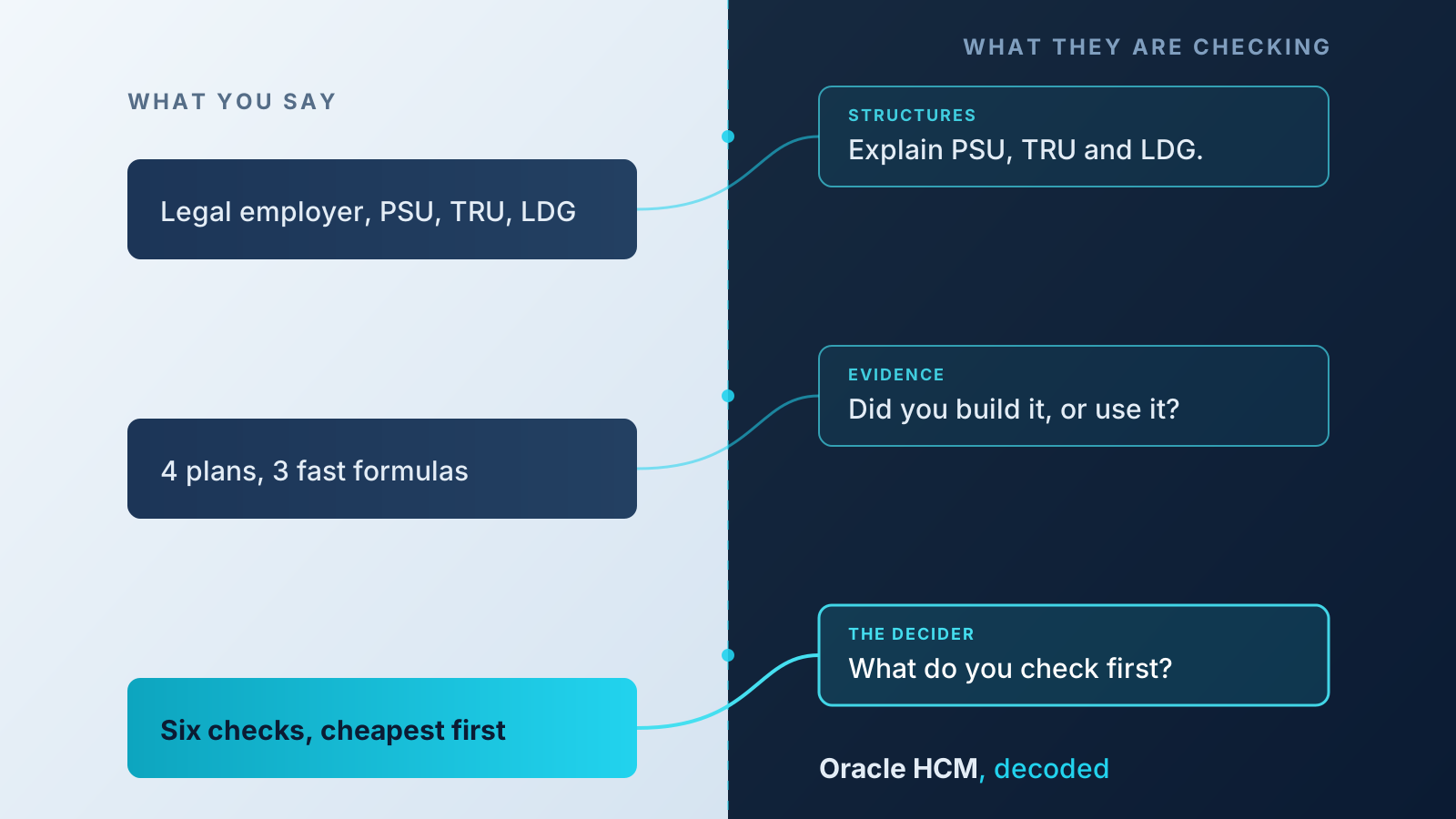
I submit candidates into these roles. I read the feedback that comes back when someone is rejected, and it is rarely what the candidate assumed. It is almost never “not technical enough”. It is usually one of three sentences: could not explain the structures, only talked about tickets, or could not tell us what they would check first.
This guide is the whole process, laid out. Who interviews you at each stage, what each of them is measuring, the questions in the order they get asked, and answers written the way you would actually say them out loud.
The problem, stated plainly
Most people prepare for one Oracle HCM interview. There are four, and they are graded by four different people with four different concerns.
You prepare a list of definitions. You revise absence plan types and element classifications. Then the client screen opens with “walk me through the enterprise structure on your last project” and you find yourself describing the project instead of the structure, and twelve minutes later you are behind and you never recover.
The material is not the issue. Almost every candidate I speak to knows more than they manage to prove in forty five minutes.
Why it happens
Oracle Fusion HCM is a configured product, not a coded one. That has an odd consequence for interviews.
In a development role, you can be asked to write something and the answer is visible. In an HCM role, everyone can describe a feature, because the feature is documented and the documentation is public. So the interviewer cannot separate people on knowledge of features. They separate people on three other things instead: whether you have seen the product break, whether you know the boundary between your module and the one next to it, and whether you can explain a decision to an HR person who does not care about the technology.
That is why the interview drifts to scenarios so quickly. A scenario is the cheapest way to find out whether you configured something or read about it.
What the interviewer is actually thinking
Four questions sit underneath everything you get asked. Notice that only the first one is about product knowledge.
Did you build it, or did you use it? There is a real difference between “I raised a service request when accruals were wrong” and “I found the accrual matrix band was set to the wrong unit of measure”. Both are honest. Only one of them shows configuration.
Do you know where your module ends? Absence touches payroll through element entries. Compensation touches payroll through salary basis. Core HR touches everything because it holds the assignment. Candidates who never worked near the seams give themselves away instantly.
What do you check first? Experienced consultants have a diagnostic order. Newer ones have a guess. The interviewer is listening for order.
Can you talk to a business user? You will spend more of the job with HR partners than with Oracle. If every answer is acronyms, the client imagines their HR director on a call with you and quietly decides against it.
The four rounds, and what each one is testing
| Round | Who runs it | Length | What passes | What fails |
|---|---|---|---|---|
| Vendor or recruiter screen | Staffing recruiter | 15 to 25 min | Clear module list, dates, rate, availability, work authorization | Vague scope, no version, unclear availability |
| Client technical screen | HRIS lead or partner solution architect | 30 to 45 min | Structures, module depth, one clean scenario answer | Feature recital, no boundaries, no debugging order |
| Panel or case round | Functional lead plus HR business owner | 45 to 60 min | Requirement to design reasoning, plain language | Over-engineering, jargon, no trade-offs |
| Business or manager round | Hiring manager | 20 to 30 min | Communication, stakeholder handling, availability | Sounding like support only, no ownership stories |
Some clients merge rounds two and three. Implementation partners usually add their own internal round before you ever meet the client. The order changes. The four tests do not.
Round 1: the vendor screen
This is my round. It is short and it is not a technical test, but more candidates fall out here than anywhere else, because they treat it as a formality.
I have to write a submission summary that a client manager reads before they read your resume. If your answers are loose, my summary is loose, and a loose summary loses to a sharp one from another vendor for the same requisition.
“Walk me through your Oracle HCM experience.”
Do not start at the beginning of your career. Start at the shape.
“I am an Oracle Fusion HCM functional consultant, seven years, all of it on Cloud rather than EBS. My core is Global Human Resources and Absence Management, with working depth in Benefits. I have been through two full implementations, both US employers, one around 4,000 workers and one around 11,000, and I supported the second one for eighteen months after go live including four quarterly updates. On the technical side I do my own HDL loads, HCM Extracts, BI Publisher reports and Global Absence Accrual fast formulas. Most recently I led the absence workstream, so plan design, configuration, testing and the cutover balances.”
Thirty five seconds. Modules, depth, scale, lifecycle stage, technical tools, most recent ownership. Every one of those is a field I have to fill in for the client.
The screening questions, and what each is really for
| Question | What it is checking | How to answer |
|---|---|---|
| “Which release are you on?” | Whether your knowledge is current | Name the update level and one recent change you handled |
| “Implementation or support?” | Fit to the requisition | Say both, in that order, with the go live named |
| “Did you configure or did you test?” | Screening out inflated resumes | Name specific objects you built |
| “How many quarterly updates have you tested?” | Whether you can hold a live client | Give the number and what you regression test |
| “What is your rate expectation?” | Whether you are inside the budget | Ask for the range first, then answer |
| “Are you available for a call this week?” | Real availability | Give two windows, not “anytime” |
The rate question
Do not answer it cold. It costs you money in both directions: too high and you are never submitted, too low and you are anchored for the whole contract.
You: “Happy to talk about the rate. What range is approved for this requisition? I would rather tell you whether it works than throw out a number that is off by twenty percent in either direction.”
If pushed for a number first: “Based on what similar Oracle HCM absence and core roles have paid recently, my expectation sits in the upper part of the usual band for this scope, and I am flexible for a longer engagement or a role with extension likelihood. Give me the approved range and I will confirm quickly.”
Rates move with location, module, whether you are W2 or corp to corp, and how hard the client is finding the skill that quarter. Anyone quoting you a fixed number for “Oracle HCM consultant” without knowing those four things is guessing.
Two things to confirm before you agree to be submitted
Ask who the end client is and whether the submission is direct or through a layer. And do not sign a right to represent for a role you cannot identify, because duplicate submissions from two vendors for the same person get both submissions dropped. It is the fastest way to lose a role you were qualified for.
Round 2: the client technical screen
Now it is real. Usually the HRIS manager, an internal Oracle lead, or the solution architect from an implementation partner. Thirty to forty five minutes, and it almost always opens with structures.
Enterprise structures: the questions that open the screen
“Explain legal employer, PSU, TRU and legislative data group.”
This is the single most common opening question in Oracle HCM interviews, and a fuzzy answer here colors the entire call.
“The legal employer is the legal entity a worker is employed by, so it is what the work relationship points at. The payroll statutory unit groups legal employers for statutory reporting and is where you register with the tax authority. The tax reporting unit sits under the PSU and is the entity that actually reports tax, so in the US that is the level carrying the EIN. The legislative data group is the payroll partition. It is tied to a country legislation, and payroll definitions, elements, balances and fast formulas all live inside one, which is why a global rollout needs one LDG per legislation rather than one per country office.”
“Business unit or division. When do you use which?”
“A division is a management and reporting grouping. A business unit is a functional partition that drives security and process ownership, and in HCM it matters most for things like recruiting, compensation and how you slice data access. I usually let the security and reporting requirement decide it rather than the org chart, because the org chart changes more often than the security model should.”
“Explain the person and assignment model.”
“The person record is unique to the individual and holds person number, national identifiers and personal information. Under that sits the work relationship with a legal employer, and under the work relationship sit the assignments that carry job, position, grade, department, location and manager. If a person leaves and comes back, you add a new work relationship to the same person record rather than creating a second person, which is the mistake that causes duplicate person numbers. On the payroll side, the payroll relationship is the top level for processing and balances, and it maps to the PSU.”
“Which employment model did you use and why?”
“Two tier with single assignment for the last client, because nobody held concurrent employment and it keeps the data and the security profiles simple. I have configured multiple assignments once, for a healthcare client where staff genuinely worked in two departments with separate managers and separate cost centers. The trap there is that everything downstream multiplies: absence entries, costing, approvals and manager hierarchies all have to be tested twice.”
Security: the questions that separate levels
“How do you give an HR representative access to only their own division?”
“Data security through security profiles. I would build a person security profile scoped by the organization or by area of responsibility, then attach it to the job role using Assign Security Profiles to Role rather than editing the seeded role. If it is a small population defined by an actual responsibility, areas of responsibility are cleaner than a hard coded profile, because HR can maintain it themselves when someone changes portfolio.”
“What is the difference between an abstract role, a job role and a duty role?”
“Abstract roles are what you are to the system regardless of your job, so Employee, Line Manager, Contingent Worker and Contact. Job roles map to the actual job, like Human Resource Specialist. Duty roles are the bundles of privileges underneath that make a role able to do something. In practice, you copy a seeded job role rather than modify it, because a modified seeded role gets overwritten in an update and you inherit whatever Oracle changed.”
That last sentence is the one that reads as experience.
“How do users get their roles automatically?”
“Role mappings, with conditions on things like system person type, assignment status, business unit or department, and the autoprovision flag set. Then the Autoprovision Roles for All Users process picks up people whose conditions changed. When somebody says a new hire cannot log in, the role mapping condition and whether that process has run are the first two things I check.”
Absence Management
“What are the absence plan types and when do you use each?”
“Accrual plans for entitlement that builds over time, so vacation and PTO. Qualification plans for entitlement tied to a period of absence rather than a balance, which is where FMLA and disability sit in the US. No entitlement plans for absences you want recorded and reported but not balanced, like unpaid personal leave or bereavement where there is no accrual. The one that gets misused is no entitlement, because it looks easy and then the client asks for a balance report six months later.”
“Accrual matrix or fast formula?”
“Matrix first, always. Banded accrual by length of service, grade or hours worked is exactly what the matrix is for, and a matrix is something the client can maintain after I leave. I move to a Global Absence Accrual fast formula when the rule depends on something the matrix cannot express, for example an accrual that varies with a union agreement or with hours captured in Time and Labor. Every formula you write is a maintenance liability, so the bar for writing one should be high.”
“An employee says their balance is wrong. What do you check?”
This is the classic scenario. Answer with an order, not a cause.
“First, whether the balance is actually wrong or whether they are looking at a projected balance rather than an as of today balance, because that is what it usually is. Then the plan enrollment, so whether they are enrolled, from what date, and whether an eligibility profile change dropped them. Then the accrual matrix band against their real service date and grade. Then whether Calculate Accruals and Balances has run since the change that they think should have moved it. Then carryover and expiry rules if we crossed a plan year. Then, only then, do I look at whether an absence was recorded against a different plan than they think.”
Six checks, in cost order, cheapest first. That answer alone passes technical screens.
Payroll, if you claim it
Payroll interviews are harder and the questions get specific fast, because the risk is statutory.
“Explain the payroll cycle end to end.”
“Calculate Payroll, then verify with the payroll register and Statement of Earnings for exceptions. Calculate Prepayments to work out payment methods and split payments. Archive Periodic Payroll Results, because payslips and most reporting read from the archive rather than the run results. Then Generate Payslips, then Make EFT Payments and the check payments process. Costing runs alongside and then Transfer to Subledger Accounting pushes it to Financials. If somebody is missed or wrong, QuickPay for the individual rather than rolling back the whole run, unless the error hit the population.”
“What are element classifications and why do they matter?”
“Primary classification drives processing order and taxability, so Standard Earnings, Supplemental Earnings, Imputed Earnings, Pre-Statutory Deductions, Involuntary Deductions, Voluntary Deductions and Information. Get it wrong and the element taxes wrong, which you find out in the first parallel run if you are lucky and after go live if you are not. And element eligibility is the step people forget. Until eligibility is defined, the element cannot be given to anyone, which is the usual reason an element entry cannot be created.”
“How does retro pay work?”
“Retroactive events are captured by event groups against the elements you flagged, then Recalculate Payroll for Retroactive Changes creates the retro element entries in the current period. The thing to check when retro does not appear is whether the element has a retro element defined and whether the change date is actually inside a period that was already processed. Backdated changes before the earliest retro date do not generate anything, which surprises people.”
“Which tax engine does US payroll use?”
“Vertex. Oracle uses it for US and Canadian tax calculation, so the tax rules themselves are not something you configure. What you configure is the tax reporting unit, the employee tax withholding card and the geography setup, and most tax defects trace back to an address or a jurisdiction on the card rather than the calculation.”
Benefits and Compensation
“An employee says they cannot see any enrollment options. Where do you look?”
“In order: has a life event been triggered at all and is it in a processed state, does the participant pass the eligibility profile attached to the program and to the plan, is the event date inside the enrollment window, is the program sequencing correct, and has Evaluate Life Event Participation been run since the data changed. Nine times out of ten it is eligibility, and inside eligibility it is usually a derived factor like length of service evaluated on a different date than the client assumed.”
“What is a salary basis and why does it matter outside compensation?”
“It defines how salary is stored and annualized, so annual, hourly or period, and it links the salary to a payroll element. That link is the reason it matters outside compensation. If the basis points at the wrong element or the frequency is wrong, the salary looks right on the person’s record and pays wrong, and nobody finds it until a payroll run.”
Talent and Recruiting
“How does a requisition become an offer in Oracle Recruiting?”
“Requisition created from a template, approved, posted to internal and external career sites. Candidates and prospects flow into the candidate selection process, which is the configurable pipeline of phases and states. Screening, interviews and assessments sit inside those phases. Then the offer, which has its own approval flow, and on acceptance the candidate converts to a pending worker or an employee, and that handoff into Core HR is where most Recruiting projects have their integration work.”
“Checklists or Journeys?”
“Journeys, for new work. Oracle has been moving onboarding and lifecycle checklists into Journeys, the task types are richer, and it is where the Redwood experience is being built. If a client is still on classic checklists I would not rip them out mid-project, but I would plan the move rather than build new ones.”
The technical toolkit questions
Even functional roles get asked these, because a consultant who cannot load data or produce a report needs a second person to do their job.
| Tool | What it is for | The question they ask |
|---|---|---|
| HCM Data Loader (HDL) | Bulk create and update through .dat files | “How do you handle a failed load?” |
| HCM Spreadsheet Data Loader | Business user loads from a spreadsheet template | “When would you use this instead of HDL?” |
| HCM Extract | Scheduled outbound data to a file or integration | “Full extract or changes only?” |
| BI Publisher | Formatted reports, payslips, letters | “How do you burst a report by manager?” |
| OTBI | Ad hoc analysis on subject areas | “Why can you not see a field in a subject area?” |
| Fast Formula | Rules the configuration cannot express | “Give me one you wrote and why” |
| Transaction Design Studio | Show and hide fields by role and action | “How do you hide a field without Page Composer?” |
| Sandboxes | Isolate and publish changes | “What do you do before publishing?” |
| REST APIs and OIC | Real time integration | “Extract or REST for this interface?” |
“How do you handle a failed HDL load?”
“Open the load results and read the error at the line level rather than the summary, because the summary tells you a file failed and the line tells you why. Most failures are one of four things: a wrong or missing source key or GUID so it cannot find the record, a date effective conflict with an existing row, a required attribute missing for that object, or a lookup value that does not exist in the target instance. I fix the file, reload only the failed lines, and if it is a migration I keep the source key mapping so reloads stay idempotent.”
“Full extract or changes only?”
“Changes only, once the initial load is done, because a full extract of a large population every night is expensive and the downstream system usually only wants deltas. Full extract for the first run, for reconciliation, and when the consuming system asks for a periodic full refresh to resynchronize.”
The scenario questions that actually decide it
Everything above can be revised. These cannot, and this is where the round is won.
“We are on the current release. Oracle applies a quarterly update in three weeks. What do you do?”
“Get the release readiness material for that update and read it against our configuration rather than in general, because most of the content will not touch us. Build the regression list from what we actually use: absence accrual runs, a payroll run in the test environment, the integrations, our custom BI reports, security for two or three key roles and any Redwood pages that changed. Test on the updated test pod as soon as it lands, because production usually follows a couple of weeks later and that window is all the time you get. Log anything broken with Oracle immediately, since a support fix takes time you may not have. And tell HR what will look different before the day it looks different, which is the part that gets skipped.”
“HR wants a field on the assignment page that is not there. Options?”
“First question is whether they want to store data or just see something. If it is storage, a descriptive flexfield on the right object, with a value set, and then decide whether it belongs on the assignment or on the person, because people put things on assignment that then multiply across every assignment change. If it is visibility, Transaction Design Studio to show or hide by role and action, which is maintainable. Page Composer only when nothing else does it, because personalizations are the things that break in updates. And for Redwood pages the answer is Visual Builder Studio, not Page Composer, which is worth saying out loud since it catches people out.”
“A manager says they cannot see one of their direct reports.”
“Assignment first: is the manager actually on that person’s assignment as line manager, and is the manager hierarchy the one the security profile uses. Then whether the change was made effective dated in the future. Then whether the person’s assignment status is active. Then the security profile behind the line manager abstract role. Then whether it is a data caching or a process timing issue rather than configuration. I check the record before I check the security, because it is the record about eighty percent of the time.”
“The client wants a customization Oracle does not support. What do you say?”
“I explain the maintenance cost in their language, not mine. Anything outside the supported extension model is something we own forever and retest every quarter. Then I ask what the underlying requirement is, because the requested solution is usually one of several ways to meet it and the other ways are supported. If they still want it, I put the decision, the risk and who accepted it in writing, and we build it properly. Saying no is not the job. Making the trade-off visible is.”
That last answer is a senior answer, and clients notice it.
The support-only trap, and how to get out of it
A large number of Oracle HCM candidates have real depth from AMS or internal support work, and get filtered anyway. Here is the mechanism.
The client asks “have you done a full lifecycle implementation?” and the honest answer is no. Most candidates then apologize, shrink, and spend the next two minutes explaining what they have not done. The client hears risk.
There is a better answer that is equally honest.
“Not from day one of a program, no. What I have done is the part of the lifecycle most implementations get wrong. I have owned the configuration after go live, which means I have fixed the design decisions that did not survive contact with real data. I have run four quarterly updates including two that broke our absence integration. I have done the data corrections, the balance adjustments and the security redesign the original project did not finish. So on a new implementation I would be strongest in design review, testing and cutover, and I would want to sit close to whoever runs the first parallel run.”
That answer converts. It names the gap without dwelling, then converts support work into the specific evidence it is.
If your experience is support, audit it for these five things and put them into words: configurations you changed rather than tickets you closed, data loads you ran, quarterly updates you tested, integrations you fixed, and anything you designed from a requirement rather than a defect. Most support consultants have all five and describe none of them. That is worth an outside read of your resume before you send it anywhere, because you usually cannot see this in your own document.
Your resume, in Oracle HCM terms
Recruiters and ATS filters look for module names, lifecycle words and tool names. Vague seniority language matches nothing.
Before
“Experienced Oracle HCM Cloud consultant responsible for supporting HR systems and resolving user issues in a timely manner. Worked closely with stakeholders to deliver solutions.”
After
“Oracle Fusion HCM functional consultant, 7 years. Global Human Resources and Absence Management lead on two US implementations (4,000 and 11,000 workers), plus 18 months post go live support across 4 quarterly updates. HDL, HCM Extracts, BI Publisher, Global Absence Accrual fast formulas, security profiles and approval rules.”
Before
“Handled absence management configuration and supported users.”
After
“Designed and configured Absence Management for 11,000 US workers: 4 accrual plans, 2 qualification plans covering FMLA and short term disability, service band accrual matrix, 3 Global Absence Accrual fast formulas for the union population, and cutover of opening balances by HDL.”
Use your real numbers, not those ones. The pattern is what matters: what you built, at what scale, with which objects named.
Keywords a real requisition contains
Work these in where they are true. Never list a module you cannot answer questions on, because the technical screen is specifically designed to find that.
Oracle Fusion HCM · Oracle Cloud HCM · Global Human Resources · Core HR · Absence Management · Time and Labor · Benefits · Compensation · Talent Management · Oracle Recruiting · Global Payroll · Fast Formula · HCM Data Loader · HDL · HCM Extracts · BI Publisher · OTBI · Security Console · security profiles · role based access control · approval rules · Transaction Design Studio · Redwood · sandboxes · descriptive flexfields · value sets · eligibility profiles · element entries · balance adjustments · QuickPay · retro pay · costing · quarterly update testing · data migration · Oracle Integration Cloud · REST API
Your LinkedIn headline and About opening
Headline. Oracle Fusion HCM Consultant | Core HR, Absence, Benefits | 2 full implementations | HDL, Extracts, Fast Formula
About, first two lines. I configure Oracle Fusion HCM for US employers, mostly Global Human Resources and Absence Management, and I stay through go live and the quarterly updates that follow. Two full implementations at 4,000 and 11,000 workers, plus the post go live work that decides whether a project was actually successful.
Recruiters search LinkedIn on module names and tool names. A headline that says “Senior Consultant at a Great Company” is invisible to that search.
Common mistakes
Listing every module. A resume claiming Core HR, Absence, Time, Benefits, Compensation, Talent, Recruiting, Learning and Payroll reads as one of two things, and neither is good. Claim two or three at depth and name the rest as exposure.
Answering configuration questions in ticket language. “I raised an SR and Oracle fixed it” is a true sentence that ends a technical screen. Say what the cause turned out to be.
No version or update level anywhere. Oracle HCM changes quarterly. A resume with no indication of how current you are gets read as older than it is.
Talking only about the tool. Half the interviewers are HR people. Explain absence design in terms of what an employee sees and what an HR partner has to maintain, not only in terms of plan objects.
Preparing definitions instead of scenarios. Definitions are the first ten minutes. Scenarios are the decision.
Never asking anything back. Ask which modules are live, what the update cadence pain is, whether they have a Redwood migration underway, and how many people sit in the HRIS team. Those questions sound like someone who has done the job.
Going quiet after the interview. A short, specific follow up genuinely helps, and almost nobody sends one.
The 10 day preparation plan
If you have an interview in a fortnight, this order works better than rereading documentation.
| Days | Focus | Output |
|---|---|---|
| 1 to 2 | Structures and person model | You can explain legal employer, PSU, TRU, LDG and assignment out loud, unprompted, in under two minutes |
| 3 to 4 | Your primary module, in depth | Ten configuration questions answered aloud, including two you would previously have fumbled |
| 5 | The module next door | Enough to explain the seam, for example how absence reaches payroll |
| 6 | Technical tools | One HDL story, one extract story, one report story, one formula story |
| 7 | Scenarios | Six debugging questions answered as an ordered checklist, not a guess |
| 8 | Your three project stories | Situation, what you owned, what you decided, what happened, in ninety seconds each |
| 9 | Resume and LinkedIn alignment | Same modules, same dates, same scale in both places |
| 10 | Rehearsal | Speak every answer out loud once. Time the long ones |
Day 10 is the one people skip and the one that matters most. Answers that read well in your head are frequently forty five seconds too long when spoken.
The follow up email
Send it within twenty four hours, to the recruiter if that is your only channel. Keep it short and put one useful thing in it.
Subject: Thank you, Oracle HCM Consultant role
Hi [Name],
Thank you for the time today. I enjoyed the discussion, particularly the part about consolidating the absence plans ahead of the payroll rollout.
One thing I did not get to say: on my last project we hit the same sequencing question, and doing the plan consolidation before the payroll cutover rather than after saved a large balance reconciliation later. Happy to walk through how we handled it if it is useful.
I am available for a next conversation any afternoon this week.
Best regards, [Your name]
One paragraph of substance beats three paragraphs of enthusiasm. It also gives the interviewer something to quote in their internal notes.
Recruiter tips you will not read elsewhere
Give me your availability in specific windows. “Anytime” reads as unemployed and unmanaged. Two named windows read as busy and organized, and they get scheduled faster.
Tell me your other processes. Not to pressure me. So I do not submit you somewhere you are already in play, which kills both.
Keep your resume dates in month and year format and identical to LinkedIn. Mismatched dates cause a background verification query later, and they cause a screening pause now.
Name the end client only when you are allowed to. Some contracts prevent it. “A US healthcare provider, around 11,000 workers” carries almost all the information anyway.
If you do not know something in the interview, say so and then say what you would do. “I have not configured Time and Labor, but I have consumed its output in absence accruals, and here is how I would get up to speed” is a good answer. Bluffing a module is the fastest possible rejection, because the interviewer configures that module for a living.
Your checklist
- Two or three modules claimed at depth, the rest named as exposure
- Release or update level visible on the resume
- Structures answer rehearsed out loud, under two minutes
- Person, work relationship, assignment and payroll relationship explained cleanly
- One named object built in each claimed module, ready to describe
- Six debugging scenarios answered as an ordered checklist
- The support-only answer prepared, if that is your background
- Three project stories at ninety seconds each
- Resume and LinkedIn showing the same modules, dates and scale
- Rate range asked for before any number given
- Two specific availability windows ready
- Follow up email sent within twenty four hours
Frequently asked questions
What questions are asked in an Oracle HCM interview?
Three layers. Structure questions about legal employer, PSU, TRU, legislative data group and the person and assignment model. Module configuration questions in your area, such as absence plan types or element classifications. Then scenario questions where something is broken and you have to say what you would check first. The last layer is what decides the outcome.
Do I need an Oracle certification to get an Oracle HCM job?
Not usually. Implementation partners often want one because Oracle partner status depends on certified staff, so it helps for those roles. End clients and staffing vendors care far more about which modules you configured and whether you have been through a go live. A certification with no hands on configuration behind it gets found out in the technical screen.
Can I get an Oracle HCM job with only support experience?
Yes, and support work counts more than people think, but you have to describe it correctly. Say what you configured rather than what you resolved. Service requests you fixed, quarterly update regression you tested, HDL loads you ran and fast formulas you amended are all configuration evidence. What loses the round is answering configuration questions in the language of ticket handling.
How long does the Oracle HCM interview process take?
For a US contract role, usually one to three weeks from submission to offer. The vendor screen and the client technical screen often happen within the same week, then a panel or business round follows. Full time roles run longer because of internal approvals. If nothing moves for ten working days after a client screen, the requisition has usually stalled rather than rejected you.
What is the difference between Oracle HCM Cloud and Oracle EBS HRMS?
They are different products, not versions of one. EBS is on premise, uses business groups and its own security model, and is customized through forms and PL/SQL. Fusion HCM is SaaS, updated quarterly by Oracle, built on legal employers and legislative data groups, configured rather than customized, and extended through fast formula, HDL, extracts and integrations.
Which Oracle HCM module has the most job openings?
Global Human Resources, because every implementation needs it, so it appears in almost every requisition. The roles with the least competition are usually Payroll and Benefits, since both carry statutory risk and clients want proven hands. Absence and Time often ride alongside Core HR. Talent and Recruiting demand rises with organizations that already went live on Core.
How do I prepare for an Oracle HCM interview in two weeks?
Spend the first days on structures and the person model, because those questions open almost every screen. Then write out and speak your three project stories. Then work through scenario questions in your own modules until you can answer with a diagnostic order rather than a single guess. Rehearse out loud. Reading the answers is not the same as saying them.
Can experienced candidates get job support without enrolling in training?
Yes. Most experienced Oracle HCM consultants do not need a course. They need sharper positioning, correct submissions and interview preparation for the technical rounds. Campus4tech offers standalone job support with no training attached, and we continue working with candidates until they are successfully placed.
Where to check things for yourself
Two sources are worth using directly rather than through blog summaries. Oracle’s product documentation at docs.oracle.com carries the implementation and administration guides for every HCM module, and it is the correct place to settle an argument about how a feature behaves. Oracle University lists the current certification tracks if you decide a certification is worth it for the partner roles.
Read release documentation for your own update level. A feature that behaves one way in an older update may behave differently now, and quoting the old behavior in an interview is a small, avoidable own goal.
Summary
Oracle HCM interviews are not knowledge tests. Almost everyone who reaches the technical screen knows the product reasonably well, so knowledge is the entry fee, not the differentiator.
Four things decide it. Whether you can explain the enterprise structures cleanly in the first five minutes. Whether you talk about what you configured rather than what you supported. Whether your answer to a broken thing is an ordered set of checks instead of a single guess. And whether an HR person on the panel understood you.
If your background is support rather than implementation, do not hide it and do not apologize for it. Convert it. The post go live work is where design decisions get tested, and a consultant who has fixed a bad design is worth more than one who has only built on a clean page.
Prepare in the order in the ten day plan. Rehearse out loud. Ask for the rate range before you give a number. And send the follow up, because almost nobody does.
If you are experienced and the interviews are the part that is not converting, that is what our job support without a training course is built for: getting the positioning right, running submissions properly so you are not lost in a vendor pile, and preparing you specifically for technical screens in your modules. It is available on its own, with no course attached, and we keep working with candidates until they are placed. If you want to talk it through first, the free consultation form takes about three minutes.
Written by
Sumit Saxena
Delivery Lead
Focuses on candidate submissions, interview coordination and employer relationships.