Career Restart
Restarting an IT Career After 40: The Rebuild That Actually Works
Anudithi Saxena · Career Consultant · · 28 min read
You are somewhere in your forties. You have been in technology for eighteen or twenty years. Then the restructure happened, or the contract ended, or you finally left a job that was making you miserable, and now you have been searching for five months with almost nothing to show for it.
Four hundred applications. A handful of screening calls. Two of them ended with the word “overqualified” and a promise to keep your resume on file.
So you start to wonder whether the real problem is your birth year.
I want to answer that honestly, because the honest answer is more useful than reassurance. Age bias in hiring is real. It is also not the thing that is stalling most of the searches I see. What stalls them is a set of signals that happen to correlate with age, and every one of those signals can be changed in about three weeks.
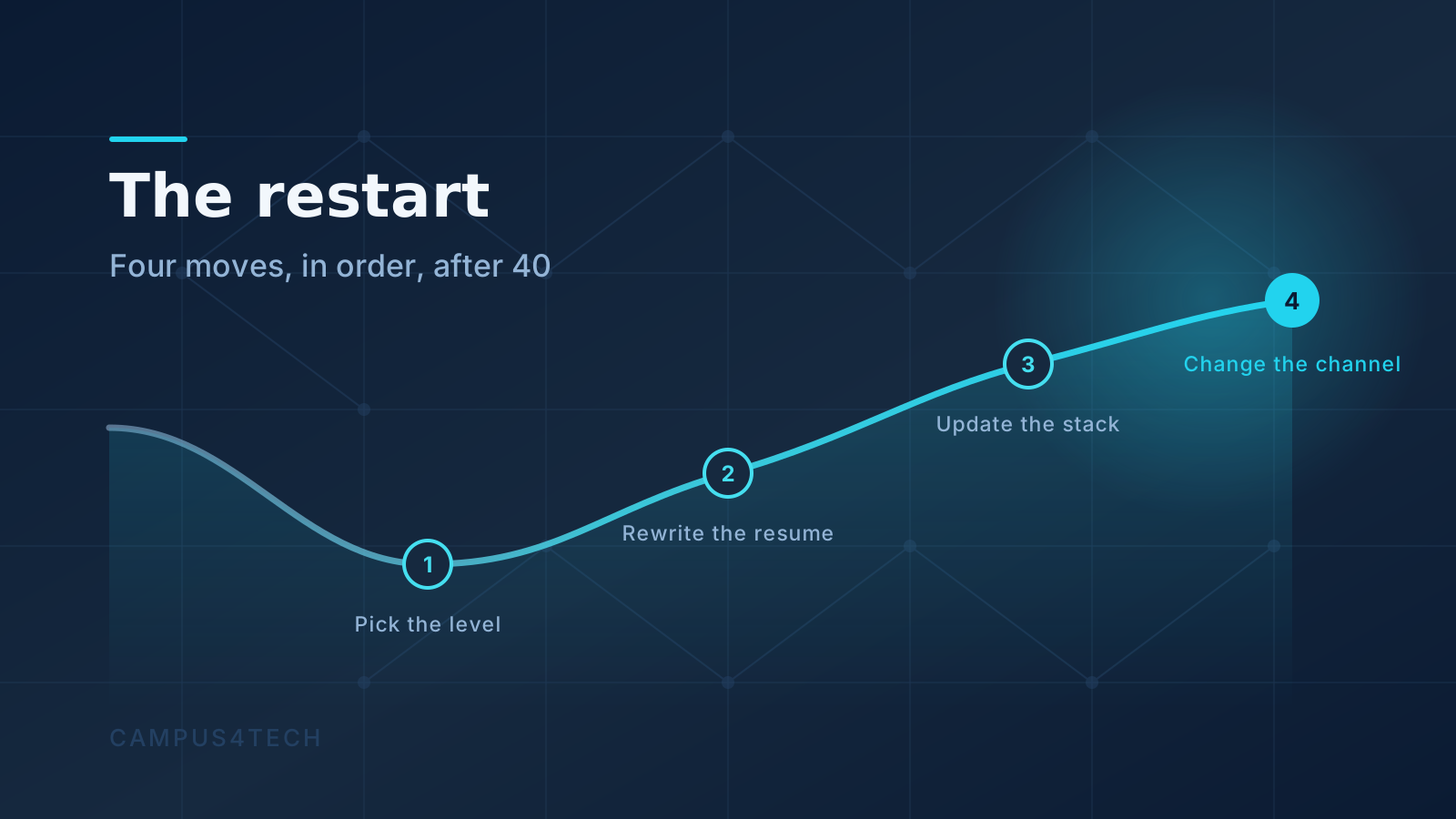
Restarting an IT career after 40 comes down to four moves, in this order. Pick a target level and name it out loud. Cut the resume back to roughly twelve years so it reads as current rather than as a career history. Close the stack gap with one certification and one thing you actually built. Then change the channel, because the job board is the worst possible door for a senior candidate.
Do those four things and the search usually changes character within a month. Not because you got younger. Because you stopped being hard to place.
Is 40 too old to restart an IT career?
No. The industry hires people in their forties and fifties constantly, and in the United States workers aged 40 and over are a protected class under federal law. What actually changes after 40 is that vague positioning stops working. A 28 year old who says “I am open to anything in tech” reads as flexible. A 48 year old who says the same thing reads as unsure, and unsure is what gets screened out.
The market does not need you to be younger. It needs you to be specific.
Here is the part nobody says at the networking event: experience is only an asset when it points somewhere. Twenty years of experience described in general terms is a liability, because the reader has to do the work of figuring out what you are for. Twenty years pointed at one clearly named role is close to unbeatable, because almost nobody applying for that role has seen as many systems fail as you have.
The problem, stated plainly
Somewhere between year twelve and year twenty, three things drift.
Your title inflated faster than your hands-on work did. You became a Lead, then a Manager, then a Director, and the last time you personally touched the deployment pipeline was 2019. Your resume still lists you as a technologist, but every bullet describes governance.
Your stack froze at whatever your last employer used. That is not laziness. It is what happens when you spend eight years being extremely good at a specific environment that the rest of the market has moved past.
And your network went quiet. The people who used to call you moved companies, retired or stopped recruiting. You still have 3,000 LinkedIn connections and almost no live relationships, which is a very different thing.
None of that is an age problem. All of it is a maintenance problem, and it is fixable.
Why it happens: the mechanism, not the platitude
People will tell you the market is tough. That is not a mechanism. Here is what is actually happening between your application and the silence.
Mechanism one: level mismatch. You apply for a Senior Engineer role at a level you last held in 2016, or you apply for a Director role in a company that has no such layer. Recruiters do not read those applications as ambitious or as humble. They read them as confused, and confusion is the cheapest thing to reject.
Mechanism two: cost anxiety. A hiring manager with a budgeted range looks at twenty years of experience and assumes the number will not work, so they never ask. This one is almost entirely solvable with one sentence, and most candidates never say it.
Mechanism three: recency screening. A recruiter searching a database is filtering on tool names, and the tool names on your resume are the ones your last employer bought in 2017. You are not being rejected. You are not appearing.
Mechanism four: the manager comfort question. Somewhere in the process, a 34 year old engineering manager quietly wonders whether you will take direction from them. Nobody writes this down. It still decides interviews. It is answerable, and I will give you the words later in this article.
Notice what all four have in common. None of them is “we do not hire people over 40.” They are all inferences drawn from a document. Change the document and the inference changes.
What the recruiter is actually thinking
I am going to write out the internal monologue, because it is more useful than a summary of it. This is roughly what runs through a recruiter’s head in the six seconds they spend on a senior resume.
Twenty two years. Okay. Last title Director of Engineering. This req is Senior Backend Engineer, hands on, 160 to 190.
Is this person going to be hands on? Bullets say “owned roadmap”, “managed vendor relationships”, “led org of 40”. I cannot tell if they have written code since 2019.
What is the comp expectation? A Director in this metro was probably at 240 plus. That is a fifty thousand dollar conversation and I do not want to have it at the offer stage.
Do they actually want this, or is this a placeholder until something bigger comes along? If they leave in four months my client will not take my calls for a year.
Next.
Read that again and notice something. There is no hostility in it and no comment about age. It is three unanswered questions and a time constraint. Every single one of those questions could have been answered in the top four lines of the resume, and none of them were.
That is the whole game. You are not fighting prejudice at this stage. You are losing to ambiguity.
Where the law actually sits, and what it does for you
In the United States, the Age Discrimination in Employment Act protects workers aged 40 and over. It applies to employers with 20 or more employees, and it is enforced by the U.S. Equal Employment Opportunity Commission. Many states have their own age discrimination statutes that cover smaller employers too, so it is worth checking your state’s rules rather than assuming the federal threshold is the only one.
Two practical things follow from that.
The first is that you do not have to volunteer your age. You are not required to put your date of birth, your graduation year or your full work history from 1998 on a resume. Leaving the graduation year off a degree is standard American practice and nobody in recruiting finds it strange.
The second is more sobering. The law gives you a remedy after the fact. It does not get you callbacks. Realistically, you will never know why a particular application went nowhere, and you cannot build a job search out of suspicion. So use the protection where it matters, and put your energy into the signals you control.
The rebuild, step by step
Step 1: Pick the level, and say it out loud
This is the step people skip, and skipping it makes every later step impossible. Before you touch the resume, decide what you are applying for. One role. One level. Written down.
The useful question is not “what am I qualified for”, because at twenty years the answer is “a lot of things”. The useful question is “what do I want to be doing on a Tuesday afternoon”, and then “what is the market title for that”.
| If your last title was | Target these now | These will stall |
|---|---|---|
| Director or VP of Engineering | Engineering Manager, Principal Engineer, Platform Lead, Head of Engineering at a smaller company | Another VP role at the same company size, unless you have a warm introduction |
| Senior Java Developer, 15 plus years | Staff or Principal Engineer, Backend Architect, Technical Lead, senior contract roles | Mid level developer reqs, which will read as a mismatch and be rejected on cost |
| IT Manager, infrastructure | Cloud Platform Engineer, SRE, DevOps Lead, Infrastructure Architect | Generic “IT Manager”, a title that is shrinking as infrastructure moves to cloud |
| Database Administrator, on-premises | Data Engineer, Cloud Database Engineer, Data Platform Engineer | DBA roles alone, where the number of open positions keeps narrowing |
| QA Manager, manual testing | QA Automation Lead, SDET, Test Architect, Quality Engineering Manager | Manual QA roles, which are being consolidated almost everywhere |
| Business Analyst, ERP | Product Owner, Functional Consultant, Solution Analyst on a named platform | Undifferentiated BA roles with 400 applicants each |
| Project Manager, IT delivery | Technical Program Manager, Delivery Manager, Scrum Master on a named stack | PMO Manager roles, which are the first thing cut in a downturn |
Pick one row. Write the target title on a sticky note and put it where you work. Every decision from here answers to that title.
Step 2: Cut the resume back to twelve years
Your resume is not an autobiography. It is an argument for one job.
Here is the structure that works for a US resume at this level. Two pages. Never three.
- Name, target title, contact line. Not “Seasoned IT Professional”. The actual title you are applying for.
- Four line summary that answers level, stack, one piece of evidence and availability.
- Technical skills, grouped, in the words the job posting uses.
- Experience, full bullets for the last ten to twelve years.
- Earlier experience, one line each with company, title and years. Or nothing at all.
- Certifications and education, no graduation year.
That “earlier experience” line is the compromise that keeps you honest without letting 2004 take up half a page:
Earlier experience: Software Engineer and Senior Engineer roles at Infotech Systems and Meridian Data, 2003 to 2012. Details on request.
One line. Nothing hidden, nothing dragging.
While you are in there, delete the things that date a document more than the dates do. An objective statement that talks about what you want. A “References available upon request” line. Skill rating bars. A street address. Any technology you would not want to be interviewed on. And a two column layout with a sidebar, which parses badly in a lot of applicant tracking systems and gains you nothing.
If you want a second pair of eyes on the finished version, you can send your resume to our team for review before you start applying. It is a faster loop than finding out through six weeks of silence.
Step 3: Close the stack gap, cheaply and provably
Here is the encouraging part. You do not need to learn a new field. You need to demonstrate that you have kept moving, and the bar for that is lower than people fear.
Two artifacts do most of the work: one recognized certification, and one thing you actually built and can talk about for ten minutes.
Certification alone is weak. A certificate with nothing behind it tells a recruiter you can pass an exam. A certificate plus a small, real, working thing tells them you can still do the job. And the second one is what closes the “has this person been hands on recently” question that killed the resume in the six second read.
| Coming from | Realistic next step | A credential that is recognized | The thing to build |
|---|---|---|---|
| On-premises infrastructure, VMware, Windows Server | Cloud Platform Engineer, SRE | AWS Certified Solutions Architect Associate, or Microsoft Certified: Azure Administrator Associate | A small multi tier environment you provisioned with Terraform, in a public repository, with a readme explaining the design choices |
| Java or .NET development | Staff Engineer, Backend Architect | AWS or Azure developer level certification | A service you wrote and deployed to a container platform, with tests and a CI pipeline |
| Database administration | Data Engineer | A cloud data engineering certification on the platform you are targeting | A working pipeline that ingests a public dataset, transforms it and loads it, orchestrated rather than run by hand |
| Manual QA | SDET, QA Automation Lead | ISTQB Advanced, plus the tooling on the job postings you are targeting | A Playwright or Selenium suite against a public demo site, in a repository, running in CI |
| IT project management | Technical Program Manager | PMP from PMI, or a scrum credential from Scrum Alliance or Scrum.org | Not code. A written case study of a delivery you ran, with the decisions and what you would do differently |
| ERP and business analysis | Functional Consultant on a named platform | Salesforce Certified Administrator, or the certification path published by the vendor whose product you know | A configured sandbox demonstrating a real process end to end |
A few honest notes on this table. Vendor certification paths change, and some enterprise platforms restrict certification to employees of the vendor’s partners and customers, which is true of parts of the Workday ecosystem. Before you pay for anything, check the vendor’s own documentation, which for the big platforms means Microsoft Learn, AWS Skill Builder, Oracle University, Salesforce Trailhead or the Google Career Certificates. Do not buy a course from a third party until you have read what the vendor itself says the path is.
And give yourself a real timeline. Eight to ten weeks of evenings gets most people through one associate level certification and one small build. Trying to do three certifications at once is how people spend six months studying instead of searching.
Step 4: Rewrite the bullets so they sound like this decade
The single most common problem on a resume at twenty years is that the bullets describe scope instead of work. Scope is what a manager brags about. Work is what gets you hired.
| Before | After |
|---|---|
| Responsible for managing a team of 12 engineers | Led 12 engineers rebuilding a payments service on AWS, cutting p95 latency from 900ms to 210ms and taking the on call page rate down by roughly two thirds |
| Oversaw migration to the cloud | Migrated 140 workloads from on-premises VMware to AWS across 14 months, standardizing provisioning on Terraform so new environments went from a two week request to a same day pipeline run |
| Managed vendor relationships and budgets | Renegotiated three infrastructure contracts during the migration, retiring two tools and consolidating monitoring onto one platform |
| Extensive experience in Java development | Built and maintained the order service in Java and Spring Boot, handling roughly 40,000 orders a day, with the test suite that gates every release |
| Responsible for quality assurance processes | Replaced a four day manual regression cycle with a 450 test Selenium and Java suite running in Jenkins, bringing release testing under three hours |
| Involved in Agile transformation | Ran delivery for four scrum teams, moved release cadence from quarterly to every two weeks, and cut the average defect escape rate over two quarters |
Look at the right hand column and notice what disappeared. Age. There is no way to read those bullets and think “this person has been coasting”, because every line contains a system, a number and a decision. That is what “current” reads like on paper. It has nothing to do with how recently you graduated.
Two rules while you are in there. Do not inflate. Every number on the page has to be one you can discuss calmly for two minutes under questioning. And do not delete good work just because it is six years old. Six year old delivery is still delivery, as long as it is described in the language people use now.
Step 5: Fix the LinkedIn headline and About section
Recruiters search LinkedIn far more than they read applications, and the headline is the highest value line you own. The default headline, which is just your last title and company, is a wasted asset.
Weak: Director of Engineering at Meridian Data
Better: Engineering Leader | Platform, Cloud, AWS | Hands on with Terraform and Kubernetes | Open to Principal and EM roles
Weak: IT Manager | Technology Professional | Experienced Leader
Better: Cloud Infrastructure Engineer | AWS, Terraform, Kubernetes | 18 years in regulated environments | Open to remote or Dallas
The About section should be six or seven sentences, written as a person speaking, and it must answer the level question in the first two lines. Here is one that works:
I build and run cloud infrastructure for companies that cannot afford downtime. Most of my last eighteen years has been in banking and insurance, which means I have spent a lot of time on the boring parts that turn out to matter: change control, disaster recovery, audit evidence, and the 3am pages nobody planned for.
The last three years I led a migration of 140 workloads from on-premises VMware to AWS, standardizing provisioning on Terraform. I did the design work and I wrote a good share of the modules, because I do not think you can run a platform team well without touching the platform.
I am looking for a senior individual contributor or lead role on a platform team. AWS, Terraform, Kubernetes. Remote, or on site around Dallas. Happy to talk about contract as well as permanent.
That last line does more than it looks like it does. It answers the level question, the location question and the engagement type question in one breath, which means a recruiter can act on your profile without a single clarifying message.
Step 6: Change the channel
This is where most searches over 40 are actually lost, and it has nothing to do with your documents.
Public job boards are the most crowded channel that exists, and they are worst at exactly the level you are targeting. Senior roles get filled through referrals, through recruiters who already know the hiring manager, and through vendors who have a submission relationship with the client. If you are spending five hours a day on applications, you are working hard in the one place where effort compounds least.
A sane weekly split for a full time search looks something like this:
| Activity | Time per week | What good looks like |
|---|---|---|
| Targeted applications | 4 hours | 8 to 12 roles you genuinely match, resume adjusted for each, not 60 sent blind |
| Warm reconnections | 5 hours | 10 messages a week to former colleagues and managers. Not asking for a job. Asking who is hiring and who is good |
| Recruiter relationships | 3 hours | 5 recruiters who actually place your role, contacted properly, kept updated every two weeks |
| Vendor and staffing submissions | 2 hours | 3 firms that submit to your target clients, with your availability and rate on file |
| Skills and build work | 6 hours | Finish the certification. Finish the repository. Actually finish them |
| Interview preparation | 2 hours | Your answers rehearsed out loud, not read |
The warm reconnection line is the one people resist most and the one that pays best after 40, because you have something a 26 year old does not: two decades of people who have seen you work. Most of them will take your message. The reason they have not called is not that they think less of you. It is that they do not know you are looking.
Here is the message. Keep it short, do not attach a resume, and never open with the ask:
Hi Ravi, it has been a while. I saw you moved to Optum, congratulations, that sounds like a big step up in scope.
I am back on the market after Meridian restructured. I am focused on senior platform and cloud engineering roles, AWS and Terraform, remote or around Dallas. Not asking you to find me anything. I just wanted people I have actually worked with to know I am looking, in case a name comes to mind.
How is the new team going?
Send ten of those a week. It takes forty minutes. It generates more real conversations than a hundred applications will.
Does location still matter for a restart?
Somewhat, and less than it did. Remote roles exist in serious numbers, but they are the most competitive listings on the internet, because a remote posting collects applicants from the entire country. On site and hybrid roles in your own metro have a much smaller applicant pool and a real advantage for a local candidate who can start quickly.
The practical move is to run both, and to be explicit on the profile about which metro you are in and what you would do. “Remote, or on site around Dallas” beats “open to remote opportunities” because it tells a recruiter which of their reqs you fit.
If you are open to relocating, say so plainly and say whether you would fund it. Ambiguity about location is a very quiet application killer.
Three worked restarts
A. 46, Java developer, 19 years, laid off from a bank
The problem: the resume opened with “Seasoned IT professional with 19+ years of experience across the full software development lifecycle”, and eight of the eleven bullets on the first job started with “Responsible for”.
After, top of page one
Michael Reyes Senior Backend Engineer. Java, Spring Boot, AWS, Kafka. michael.reyes@email.com | 214 xxx xxxx | Dallas, TX or Remote | linkedin.com/in/michaelreyes
Backend engineer with twelve years building and running high volume transaction services in banking, most recently the order and settlement path handling roughly 40,000 transactions a day. Rebuilt that service on AWS with Spring Boot and Kafka, cutting p95 latency from 900ms to 210ms. AWS Certified Solutions Architect Associate, 2026. Available immediately for a senior individual contributor role.
The nineteen years became twelve on the page, and the person got stronger, not weaker. Everything before 2013 sits on one line at the bottom. The certification year does one job, which is to prove the last relevant thing he did was this year.
B. 52, IT project manager, wants to stay out of code
The problem: applying to Scrum Master roles at half the previous salary out of anxiety, and getting rejected on overqualification every time.
The fix was not the resume. It was the target. A Technical Program Manager role uses everything a long delivery career gives you, sits at a comparable level, and is a title that is growing rather than shrinking.
After, summary
Technical Program Manager with fourteen years delivering platform and integration programs in healthcare, working across engineering, security and vendor teams. Ran the delivery of a claims platform migration across nine workstreams and three vendors, landing it inside a regulatory deadline. PMP, and a certified scrum credential. Comfortable in the technical detail without being the person writing the code.
That last sentence is doing deliberate work. It answers the exact question a hiring manager has about a fifty two year old program manager, which is whether they can hold a conversation with engineers. He would have been asked it in every interview. Now he is not asked it at all.
C. 44, on-premises infrastructure, pivoting to cloud
The problem: fifteen years of VMware, Windows Server and storage, in a market where those job titles keep thinning out. He had also spent seven months studying and not applying, which is its own trap.
The fix was to stop treating the pivot as a new career. His summary now leads with the thing that transfers:
After, summary
Infrastructure engineer with fifteen years running production environments in regulated industries, moving into cloud platform work. Migrated 140 workloads from VMware to AWS over 14 months, standardizing provisioning on Terraform so new environments went from a two week request to a same day pipeline run. AWS Certified Solutions Architect Associate and HashiCorp Certified: Terraform Associate, both 2026. Public repository of Terraform modules for a three tier reference environment.
Nobody reading that thinks “career changer”. They think “infrastructure engineer who is current”. Which is the accurate reading, and it took a rewrite plus one certification, not a bootcamp.
If you are experienced and the honest gap is smaller than it feels, it is worth knowing that our job support for experienced candidates is available on its own, with no training program attached. Most people at this stage do not need to be taught. They need to be positioned and submitted.
The interview questions you will actually be asked
“You have more experience than this role requires. Why are you interested?”
The instinct is to reassure. Resist it. Reassurance sounds like pleading. Give a reason instead.
“It is a fair question. I ran a team of twelve for four years and I was good at it, but the part of the job I actually enjoyed was the platform work, and I was doing less of it every quarter. So this is a deliberate move back toward being hands on, not a step I am taking because nothing else came up. On comp, I have seen the range for this role and it works for me, so that is not something we will get stuck on later.”
Three things happened there. A reason, not an apology. A direct statement that it is intentional. And the salary landmine defused before it could sit in the process for four weeks.
“How do you feel about reporting to someone younger than you?”
They will rarely ask this outright. They will think it every time. Answer it before it is asked, in the part of the interview where you describe how you work.
“The best manager I had was about ten years younger than me. What made it work was that I brought her problems with options attached rather than expecting her to figure things out for me. I have been the manager and I have been the engineer, and honestly the engineer job is easier when you have done the other one, because you know what your manager actually needs from you.”
“What have you been doing since your last role ended?”
Short, factual, forward facing. Never defensive.
“Two things. I finished the AWS Solutions Architect certification in March, which I had been putting off for years while I was managing. And I built out a Terraform reference environment to get properly fluent with modules and state management rather than just reading about them. It is public, I am happy to walk you through the design choices.”
“What are your salary expectations?”
If your number genuinely has to come down from your last role, say so on your own terms rather than being discovered.
“My last base was 215, and that was a Director role with a much bigger management load. For a hands on senior engineering role I am working to a range of 175 to 195 depending on the rest of the package, and I have made my peace with that trade because it is the work I want to be doing. Where does this role sit?”
Naming the drop yourself removes its power. Left unspoken, it becomes the reason they pass.
Should you consider contract work?
Yes, and more seriously than most people over 40 do.
Contract and vendor roles are frequently the fastest door back in, for a reason that has nothing to do with your ability. A permanent hire is a long commitment and a slow committee decision. A contract hire is a shorter commitment and a faster one, which means the manager’s caution costs less and they say yes sooner. Six months of recent, relevant, verifiable work on your resume changes every conversation that follows it.
A few things to be clear about before you go down this route.
Understand the engagement type. W2 contract means the staffing firm employs you and handles withholding. Corp to corp means you are working through your own entity and handling your own taxes and insurance. The rates are not comparable without doing the math on benefits, employer taxes and unpaid time between contracts.
Ask about the submission. A reputable firm tells you which client they are submitting you to and asks permission first. If a recruiter will not name the client before submitting, that is worth pushing back on, because duplicate submissions from two vendors get a candidate blocked at the client end and you will never be told why.
Never pay to be placed. No legitimate staffing firm charges a candidate a placement fee. Neither does anyone who is genuinely going to get you hired.
Common mistakes, and what to do instead
| Mistake | Why it hurts | Do this instead |
|---|---|---|
| Applying to everything from junior to Director | Reads as unfocused, and gets rejected at both ends | One target level. Adjacent levels only when you have a warm introduction |
| Hiding the last twenty years entirely | Your LinkedIn contradicts your resume, and background checks surface it | Trim to twelve years and put earlier roles on one summary line |
| Studying for six months instead of searching | The market forgets you, and the gap grows while you prepare for it | Search and study in parallel. Apply from week one, imperfect resume and all |
| Waiting until you feel “ready” | There is no ready. Confidence follows activity, not the other way round | Book the certification exam with a date. Apply before you pass it |
| Treating “overqualified” as final | It is a worry, not a verdict, and it is answerable | Answer it in the summary and again in the first call |
| Chasing only fully remote roles | The most competitive listings on the internet | Run remote and local in parallel and say which metro you are in |
| Going quiet with a recruiter for three weeks | You fall off their list without being rejected | A short update every two weeks, no pressure |
| Rewriting the resume for the ninth time | It has become a way to avoid the harder work | Ten warm messages a week. Every week. That is the harder work |
Recruiter tips you will not read elsewhere
Put a 2026 date on the page somewhere. A certification, a course, a repository. One current year on an otherwise historical document changes how the whole thing reads.
Match the posting’s exact words. If the job says “Kubernetes” and your resume says “K8s”, a keyword search may not connect them. Use both, once each, where it is true.
Do not use a functional resume. The skills based format with no clear dates is read by every recruiter as an attempt to hide something. It creates the suspicion it was meant to prevent.
Answer within a business day. Availability is a real competitive advantage over younger candidates who are interviewing casually while employed, and recruiters notice it immediately.
Ask the recruiter what the hiring manager is worried about. Most will tell you, because a candidate who addresses the concern makes them look good. It is the single most useful question in a screening call.
Do not oversell adaptability. Saying “I am very adaptable and a fast learner” three times reads as defensive. One concrete piece of evidence beats every adjective.
Keep a submission log. Company, date, vendor, recruiter, role. At this level you will be submitted by multiple firms, and duplicate submissions get candidates quietly blocked.
Your restart checklist
- One target title written down, and every application answers to it
- Resume cut to two pages, full bullets for the last ten to twelve years
- Earlier roles on one summary line, or removed
- Graduation year removed from the degree
- Objective statement, references line and skill bars deleted
- Every bullet contains a system, a number or a decision
- One certification chosen, with an exam date booked
- One thing built, public, that you can talk through for ten minutes
- LinkedIn headline rewritten with target role, stack and availability
- About section answers level, location and engagement type in the first three lines
- Ten warm reconnection messages sent this week
- Five recruiters who genuinely place your role, contacted and kept updated
- Two or three staffing firms with your availability and rate on file
- Your salary sentence rehearsed out loud
- Your overqualified answer rehearsed out loud
- A submission log started
What the first ninety days should look like
| Weeks | Focus | The thing that must be finished |
|---|---|---|
| 1 to 2 | Target and documents | Title chosen, resume rebuilt, LinkedIn rewritten. Applications start in week 2 even if nothing feels finished |
| 3 to 6 | Reconnection and study | 10 warm messages a week, every week. Certification exam booked with a date |
| 7 to 10 | Evidence and submissions | Certification passed, build published, staffing firms briefed, first interviews landing |
| 11 to 13 | Conversion | Interview answers rehearsed out loud, offers negotiated as a package, references warmed up |
If nothing has moved by week eight, the problem is almost never effort. It is usually the target. Go back to step one and narrow it further.
Frequently asked questions
Is 40 too old to restart an IT career?
No. The technology industry hires people in their forties and fifties constantly, and in the United States workers aged 40 and over are a protected class under federal law. What changes after 40 is not whether you can be hired. It is that vague positioning stops working. You need a named target level, a current stack, and a resume that stops at about twelve years.
Why do employers keep telling me I am overqualified?
Overqualified is rarely about ability. It is usually one of three worries: that you will leave when a better offer arrives, that the salary will not work, or that a younger manager will be uncomfortable managing you. All three are answerable. The mistake is treating it as a compliment and moving on, instead of addressing the worry directly in the interview.
Do employers discriminate based on age in tech hiring?
Age discrimination against workers 40 and over is illegal in the United States under the Age Discrimination in Employment Act, enforced by the EEOC, and it still happens, usually as quiet screening rather than anything stated out loud. You cannot control that. You can control the two signals that trigger it most often: a resume that reads as dated, and a stack that stopped five years ago.
Should I remove old jobs and my graduation date from my resume?
Yes to trimming, no to hiding. Give full bullets for roughly the last ten to twelve years and one line each for anything older, or drop the oldest roles entirely. Leaving the graduation year off your degree is normal American practice and is not deceptive. Deleting real experience you would be asked about is different, and it tends to surface in the background check.
How do I explain applying for a role below my last title?
Say why you want this level, not why you are willing to accept it. Something like: I have run teams, and what I want now is to be hands on with the platform again, so this is a deliberate choice rather than a fallback. Then confirm the salary range works for you. The recruiter needs one sentence they can repeat to the hiring manager without hedging.
Can I move into cloud or AI roles after 40?
Yes, and often faster than someone starting fresh, because the hard part of those roles is systems judgment rather than syntax. The realistic route is adjacent, not a leap. Move from database administration into data engineering, from infrastructure into cloud platform work, from manual testing into automation. Add one recognized certification and one thing you actually built. Certification on its own rarely moves a recruiter.
Can experienced candidates get job support without enrolling in training?
Yes. Most professionals over 40 do not need a course. They need targeting, a rebuilt resume and someone putting their name in front of employers. Campus4tech offers standalone job support with no training attached, covering resume and profile rebuilds, applications, employer submissions and interview preparation. We continue working with candidates until they are successfully placed.
Summary
The search is not stalled because you are 46. It is stalled because a recruiter spent six seconds on your resume and could not tell what level you want, whether you have been hands on recently, or whether the money would work. Those are three answerable questions.
So answer them. Pick one target title and stop applying to everything else. Cut the resume to twelve years so it argues for a job instead of narrating a career. Add one certification and one real thing you built, so there is a current year on the page. Then move your effort out of the application box and into the ten people a week who already know how you work.
Two decades of having seen systems fail is the most valuable thing in the room. It just has to be pointed somewhere specific before anyone can use it.
If you are experienced and your search has gone quiet, this is exactly the situation we work on every week. You do not need to enroll in a training program to get help. Our job support is available on its own, covering targeting, resume and profile rebuilds, employer submissions and interview preparation, and we continue working with candidates until they are successfully placed. The career restart form takes about three minutes, and we will come back to you and look at where your search is actually losing people.
Written by
Anudithi Saxena
Career Consultant
Advises candidates on positioning, interview preparation and career transitions.