Getting Hired
"UAE Experience Required": What Employers Actually Mean, and How to Get Hired Without It
Sony Aggrawal · Talent Partner · · 17 min read
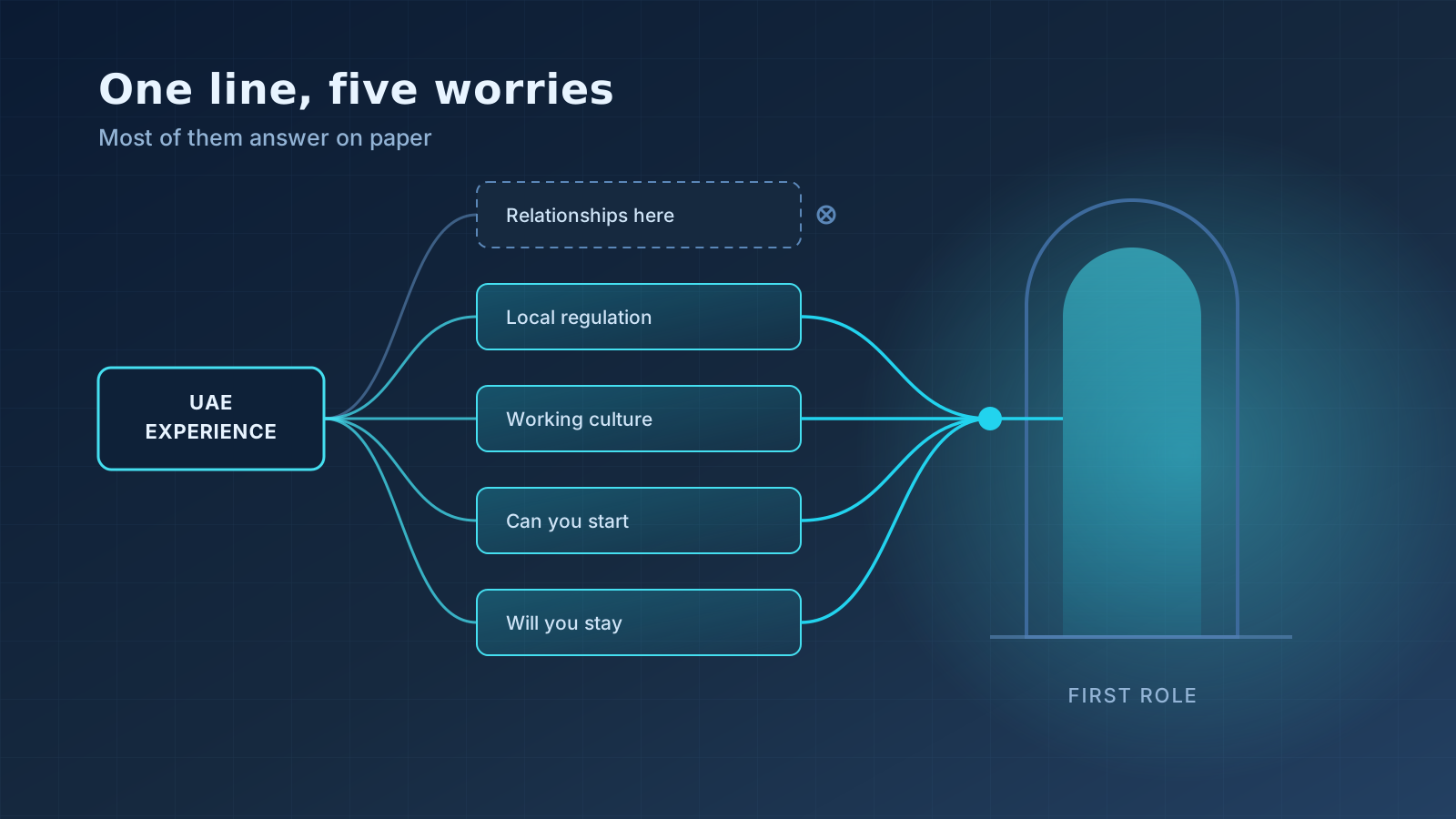
You have eight years of solid experience. Good employers, real results, references who would take the call. You apply for a role in Dubai that you could do comfortably, and the reply comes back in two lines: thank you, we are looking for candidates with UAE experience.
And the question that follows is a fair one, asked quietly by thousands of people every week. How is anyone supposed to build UAE experience if nobody will give them the first UAE job?
It is a genuine circle, and it deserves a straight answer rather than encouragement. Every single professional in this country who now has ten years of local experience once sat where you are sitting, with none. Somebody hired them anyway. The useful question is not whether the requirement is fair. It is what that requirement is actually testing, because once you know that, most of it can be answered on paper before you have ever worked here.
That is what this article is. Not a pep talk. A breakdown of the five things “UAE experience” is standing in for, and what to write, say and do about each one.
The requirement, taken seriously
Let us be honest about both sides of this, because pretending the requirement is pure prejudice will not get you hired.
Hiring someone into the UAE is a bigger commitment than hiring someone in most markets. The employer sponsors the residency visa. There is cost, paperwork and time in that, and if the hire leaves after four months the employer absorbs all of it and starts again. Add relocation support, and a wrong hire becomes an expensive mistake that somebody has to explain internally.
So a hiring manager under time pressure reaches for the fastest available proxy for “this person will work out”. Local experience is that proxy. It is not precise and it is not the only signal available, but it is quick, and quick is what a manager with 180 applications wants.
Here is the part that matters for you. A proxy can always be replaced by the thing it stands for. If you can show the underlying qualities directly, the proxy loses its job.
What “UAE experience” is really asking
Break the phrase apart and you find five separate concerns wearing one coat. They are not equally serious, and they are not equally hard to answer.
| The real concern | How hard it is for you to answer | Where you answer it |
|---|---|---|
| Do you know the local regulations and standards that govern this job? | Depends entirely on the role. Sometimes genuinely hard | CV, certifications, the technical part of the interview |
| Do you already have relationships and market knowledge here? | Hard, and honestly the one you often cannot fake | Only relevant in a minority of roles |
| Can you work effectively in a fast, multinational, hierarchy aware environment? | Easy, if you have worked internationally | CV bullets, interview stories |
| Can you actually start, and when? | Easy, and almost nobody does it well | Top of the CV, first line of the covering email |
| Will you still be here in a year? | Medium, and it is the concern nobody says out loud | Interview, and how you frame the move |
Four of those five are answerable today. Only the second one is a genuine wall, and it only stands in front of a specific set of roles. Everything below deals with them one at a time.
Concern 1: local regulation and standards
This is where the requirement is sometimes completely legitimate, and being clear eyed about it saves you months of wasted applications.
Some roles are genuinely bound to local rules, and no amount of international experience substitutes:
- Finance and accounting work touching UAE VAT and the corporate tax regime introduced in recent years
- Healthcare roles requiring a licence from the Dubai Health Authority, the Department of Health in Abu Dhabi, or the Ministry of Health and Prevention, depending on the emirate
- Real estate roles regulated by RERA
- HR and payroll covering UAE labour law, end of service benefits, WPS and Emiratisation obligations
- Legal and compliance work, particularly anything inside DIFC or ADGM, which operate their own frameworks
- Government and semi government tendering, where the process is the job
If your target sits in that list, do not fight the requirement. Close it. Take the licensing exam, complete the local certification, or start in an adjacent role and move sideways once you are in the country. That is a plan. Applying for the same regulated role forty times is not.
For everything else, and it is most things, the “local knowledge” argument is thinner than it sounds. A backend engineer, a supply chain planner, a product manager, a QA lead, a graphic designer, a school teacher, a project manager: the work is the work. In those roles the requirement is usually habit, copied from the last job advert the company posted.
What to write when you have closed the gap:
Regulatory: UAE VAT and corporate tax fundamentals, completed 2026. IFRS reporting across 9 entities in previous role. Familiar with WPS and end of service calculation.
One line, in your skills block, and the fastest objection in the pile is gone.
Concern 2: relationships and market knowledge
This is the honest one. If a company is hiring a Sales Director specifically to open doors at Emirati family groups they do not currently reach, then existing relationships are the actual job. Nobody can argue their way past that, and you should not try.
But notice how narrow that really is. It applies to senior commercial roles, business development in relationship led sectors, and roles where the brief is explicitly market entry. It does not apply to the finance manager, the operations lead, the developer or the marketing manager.
And there is a version of this that works in your favour. Your market knowledge is an asset when the company wants your market. A UAE business expanding into India, Egypt, the Philippines, Kenya or the UK needs someone who knows that market from the inside. That is not a compromise position. That is the strongest possible application, and it is the single most underused route into this country.
Covering email line that uses it
I noticed from your announcement in March that you are opening a Bengaluru office. I have spent six years selling into exactly that market, I know the distributor landscape there, and I am relocating to Dubai this year. That combination may be more useful to you than another Dubai based candidate.
Search the trade press for companies announcing expansion into your home market. Those are your thirty best applications.
Concern 3: can you work here effectively
This one is easy and almost everyone wastes it.
UAE workplaces are unusually international. A normal team might hold eight nationalities and four first languages. Communication has to be clear, hierarchy is often more visible than in Western Europe or North America, the pace is quick, and the working week runs Monday to Friday with a Friday that finishes early in the public sector.
If you have worked in any multinational environment, you already have the evidence. You just have not written it down. Stop saying “excellent communication skills”, which is on every CV in the pile and means nothing, and prove it instead.
| Weak, and on every CV | Evidence a hiring manager can use |
|---|---|
| Excellent communication and interpersonal skills | Managed a delivery team of 11 across India, Poland and the Philippines, running daily handovers across a six hour time difference |
| Adaptable and quick to learn | Relocated to Warsaw at four weeks’ notice to stabilise a failing rollout, and was running the client relationship within two months |
| Culturally aware | Sold to enterprise clients across seven countries, adapting the process for procurement norms in each |
| Works well under pressure | Held the customer relationship through a nine day outage, including three escalation calls with their board |
| Strong customer service skills | Ran a support function handling 400 tickets a week at a 94 per cent satisfaction score across three languages |
The right hand column does not mention the UAE once, and it answers the cultural fit question far better than the phrase “UAE experience” ever would.
If you are not sure how yours currently reads to somebody screening a hundred CVs, you can send your CV to our team for a review and we will tell you which column you are in.
Concern 4: can you actually start
This is the objection almost nobody addresses, and it is the cheapest one to kill.
A recruiter looking at an overseas applicant is silently working through a list. Do they have a visa. Who pays to relocate them. What is their notice period. Will they need three months and a flight before they can be in the office. Is this going to be complicated.
Complication is what gets you deleted. Not your nationality, not your lack of local experience. Complication.
So remove it, in plain words, at the top of the page.
Availability: Currently in Manila, 30 days’ notice, funding my own relocation, available for interview on video at any time and in Dubai from 15 September.
Availability: In Dubai on a visit visa until 12 October, available to start immediately, no relocation cost to the employer.
Availability: UAE residency via spouse sponsorship, no employment visa required, available immediately.
That last one deserves special mention. If you already hold residency through a spouse or a Golden Visa, put it on page one in bold. It removes the entire sponsorship cost from the employer’s decision, and a surprising number of candidates leave it buried on page two or omit it entirely.
Concern 5: will you stay
Nobody asks this directly, and everybody thinks it.
The worry is specific. Somebody arrives, finds the cost of living higher than expected, misses home, struggles through the first summer, and leaves in month five. The employer pays for that twice.
You defuse it by showing the decision is considered rather than romantic. Two or three sentences in the interview, delivered calmly:
“This is not a spontaneous move for me. I have visited twice, I have costed out housing and schooling for the two of us, and my wife has already started her own search here. We have family in Sharjah, so the support network exists. I am looking at this as a five to ten year move, not a one year experiment. I would rather tell you that now than have you wonder about it.”
Notice what makes it work. Specifics. Numbers. Named people or places. A stated time horizon. Anybody can say they are committed. Very few candidates say they have costed the schooling.
The interview answer for “you don’t have UAE experience”
It will be asked, sometimes in the first two minutes. Prepare this properly, out loud, until it runs under ninety seconds.
“That is true, this would be my first role based here. What I would say is that the parts of the job that are UAE specific, I have deliberately closed. I finished the UAE VAT and corporate tax course in March and I have been through the end of service calculation in detail. What I am bringing is nine years running finance for a multi entity business across four countries, including two ERP migrations and a group audit, which from the job description is the harder half of this role. On the local side I would expect to be behind for the first two months and I have planned for that. On the technical side I would expect to contribute from week one.”
Four moves in there, and all four matter. Acknowledge it without apology. Show the specific gap has been actively closed. Point to the part of the job that is harder and which you have already done. Give an honest ramp estimate rather than claiming there will be none.
The last move is the one that changes minds. Claiming no learning curve makes you sound naive. Naming the curve and showing you have already planned for it makes you sound senior.
The routes that actually work for a first UAE role
Applying cold to adverts that say “UAE experience required” is the worst use of your time. These convert far better.
| Route | Why it works |
|---|---|
| Multinationals with a UAE office | Global hiring standards, less attachment to the local experience filter, and sometimes an internal transfer route from your current employer |
| Companies entering your home market | Your market knowledge is the reason they hire you, not a gap to be excused |
| Staffing vendors and consultancies | They place people into client sites constantly and are far more open to strong candidates without local history |
| Contract and project roles | Fixed scope, fixed end date, so the “will you stay” concern disappears and one contract makes you a local candidate forever |
| Free zone SMEs | Smaller teams, faster decisions, and the hiring manager is often the founder rather than a filter |
| Internal transfer from your current employer | The single easiest route, and the most overlooked. If your company has any UAE presence, start there this week |
| Referral into a target company | The channel with by far the best conversion rate, and the one that bypasses the CV screen entirely |
Take the fourth one seriously, because it is the shortest path. A single six month contract in Dubai converts you from “no UAE experience” to “UAE experience” permanently. It is not a compromise. It is the entry fee, and it is often paid once.
Our current job openings are worth watching for exactly this kind of role, and if you want somebody actively submitting you to employers rather than applying alone, that is what standalone job support is for. It carries no training course attached, which matters if you are already experienced and simply need doors opened.
Should you move first and look after?
Being in the country genuinely helps. You can take an interview at two hours’ notice, you meet people properly, and the availability objection evaporates.
But do it with a funded runway of at least six months, and preferably a plan built before you land. A visit visa with a ticking clock and three months of savings creates pressure, and pressure makes people accept roles they should have refused, or hand money to somebody promising a shortcut.
If you cannot fund that, build the referral pipeline remotely first, get to a shortlist, then fly for the final stage. It is slower and it is far safer.
Protect yourself while you search
One necessary warning, because people searching hard are people who can be taken advantage of.
Under UAE rules, the cost of recruitment and the employment visa is the employer’s to carry, not yours. So treat every one of these as a stop sign:
- Anyone asking you to pay for a job offer, a visa, or a “processing fee”
- Any promise of a certain job in exchange for money
- An offer letter that arrives without a single interview
- A recruiter who will not name the client, ever, at any stage
- Pressure to decide within hours
- A request for your passport scan before any real conversation has happened
Verify the company exists and is trading. Check the offer against MOHRE guidance at mohre.gov.ae. And if something feels engineered to rush you, it is.
We should also say plainly what we do and do not promise. Nobody honest can tell you a job is certain before an employer has said yes. What we do is work with candidates until they are successfully placed, which is a different sentence and a true one.
Common mistakes
| Mistake | Why it costs you | Do instead |
|---|---|---|
| Applying to roles that say “UAE experience required”, cold, at volume | You are the exact candidate the filter was written to remove | Route around the filter through referrals and internal transfers |
| Leading the covering email with an apology for not having local experience | It frames the whole application around your weakest point | Lead with the hardest part of the job that you have already done |
| Leaving visa status and notice period off the CV | Uncertainty is deleted faster than any weakness | Put an availability line at the top of page one |
| Offering to work for far less to compensate | It reads as a mismatch, not a bargain, and sets your salary for years | Compete on evidence, negotiate the package once they want you |
| Applying for anything and everything | An unfocused candidate cannot be introduced by anybody | Thirty named companies you would genuinely say yes to |
| Waiting for the perfect permanent role | Permanent roles have the highest bar for a first UAE hire | Take the contract, become a local candidate |
| Going quiet after a rejection | The manager who rejected you this quarter is hiring again next quarter | Reply once, graciously, and stay on the radar |
A word to the hiring managers reading this
The requirement is understandable. Visa sponsorship is a commitment, and nobody wants a hire who leaves in month four. But it is worth asking occasionally what the phrase is doing in a particular job advert, rather than in job adverts generally.
If the role is regulated, or genuinely relationship led, the requirement is doing real work. Keep it.
If it is not, and it has simply been carried over from the last advert, it is quietly removing people who bring years of international delivery, several languages, unusual adaptability and a strong reason to succeed. Every person on your current team who has fifteen years of UAE experience got their first chance from somebody who looked past the same line.
Potential alongside local experience, rather than instead of it. That is all the argument needs to be.
Your checklist
- You know whether your target role is genuinely regulated or just habitually filtered
- If regulated, the local certification is booked or completed
- Availability line sits at the top of page one, with notice period and visa status
- Residency through a spouse or Golden Visa, if you have it, is in bold on page one
- Every soft skill claim replaced with evidence carrying a number
- Thirty target companies named, weighted towards multinationals, market entrants and vendors
- At least five of them are expanding into your home market
- You have checked whether your current employer has any UAE presence
- Contract and fixed term roles are in scope, not filtered out
- The “no UAE experience” answer rehearsed out loud, under ninety seconds
- A calm, specific two sentence answer for why you are staying long term
- You have never paid anybody for a job offer or a visa, and you never will
Frequently asked questions
How can I get a job in the UAE without UAE experience?
Answer what the requirement is actually testing. Employers use it as shorthand for local regulatory knowledge, existing relationships, cultural fit, certainty that you can start, and confidence that you will stay. Four of those five can be evidenced on your CV today. Target multinationals, businesses entering the market and staffing vendors, and get a referral rather than applying cold.
Why do UAE employers ask for UAE experience?
Usually not as a bias against outsiders. Sponsoring a visa is a real financial and administrative commitment, and a hire who leaves in four months is expensive. Local experience is a fast proxy for someone who understands the regulations, knows the market, communicates well across many nationalities, and is unlikely to leave in the first year.
Which UAE jobs genuinely need local experience?
Roles tied to local regulation or local relationships. Accounting and tax work touching UAE VAT and corporate tax, healthcare roles needing DHA, DoH or MOHAP licensing, real estate under RERA, HR handling UAE labour law and Emiratisation, and government tendering. Outside those, the requirement is very often habit rather than a real constraint.
Should I move to Dubai first and then look for a job?
Only with a funded runway of several months and a plan, never on hope. Being in the country removes the availability objection and makes interviews easy, but a visit visa clock puts pressure on your decisions and pressure produces bad ones. If you cannot fund six months, build the referral pipeline remotely first and travel for interviews.
Is it a red flag if a company asks me to pay for a UAE visa or job offer?
Yes. Under UAE labour rules the employer bears the cost of recruitment and the employment visa. Anyone asking you to pay for a job offer, a visa or a promise of work is a warning sign. Verify the company, check the offer against MOHRE guidance, and never send money to secure a role.
Can experienced professionals get job support without enrolling in training?
Yes. Most people relocating with solid international experience do not need a course, they need positioning, targeting and someone putting their name in front of employers. Campus4tech offers standalone job support with no training attached, covering CV rebuilds, applications, employer submissions and interview preparation. We continue working with candidates until they are successfully placed.
Summary
“UAE experience required” is one phrase covering five different worries. Local regulation, existing relationships, cultural fit, certainty that you can start, and confidence that you will stay.
Only one of those is a wall, and it stands in front of a minority of roles. Close the regulatory gap where it is real. Replace every soft skill claim with evidence a manager can use. Put your notice period and visa status at the top of page one so nothing about you looks complicated. Then stop applying cold to the adverts carrying the filter, and go through multinationals, market entrants, vendors, contracts and referrals instead.
One contract here, even six months, and you never see that line in a rejection email again.
To everyone currently applying, interviewing and waiting: one requirement in one job advert is not a verdict on your worth. Fix what can be fixed, route around what cannot, and keep going.
If you are trying to break into the UAE market and want somebody in your corner who submits candidates to employers every week, that is what we do. Campus4tech works with experienced professionals on positioning, CV rebuilds, applications, employer submissions and interview preparation, with no training course attached, and we continue working with candidates until they are successfully placed. The career restart form takes about three minutes, and you can tell us there about the roles you have been rejected from.
Written by
Sony Aggrawal
Talent Partner
Supports candidates through applications, offers and onboarding into new roles.