Interview & Resume
Workday Interview Guide: The Questions That Prove You Worked in a Real Tenant
Anudithi Saxena · Career Consultant · · 37 min read
You have Workday on your resume, the recruiter sounded genuinely interested, and then the client screen turned into twenty five minutes of questions you half knew. Or worse, the call went fine and you never heard back.
I sit with candidates after those calls. The pattern is remarkably consistent, and it is almost never a knowledge problem in the way people assume. It is that Workday interviews are not really testing what you know. They are testing whether you have been inside a tenant, and most candidates have never been told that is the actual question.
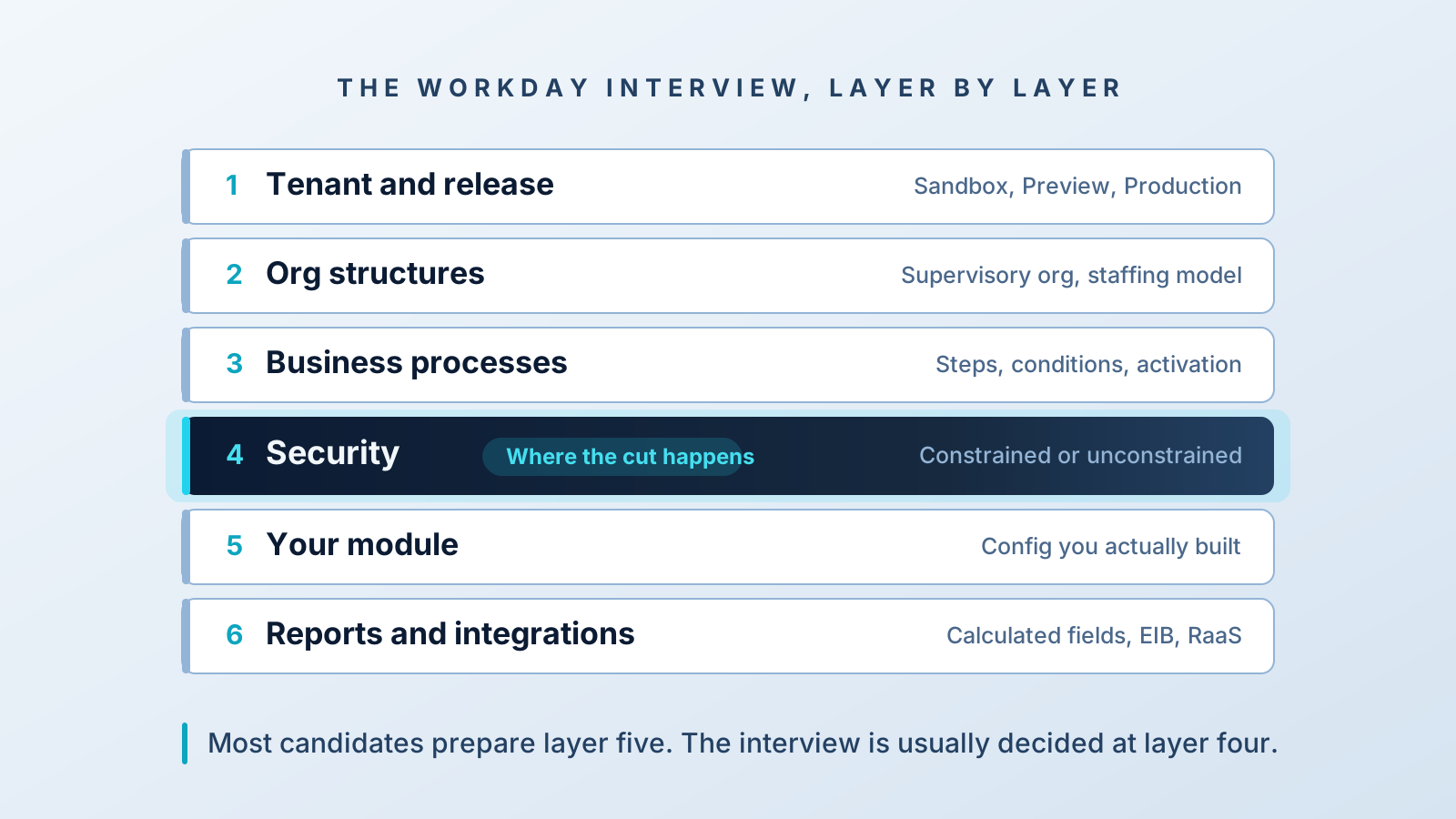
This guide walks through the six layers a Workday interview moves through, the questions asked at each one, and the answers that pass. Every model answer here is written at spoken length, so you can read it out loud and time it. If you are already working in Workday and just want the parts that get people cut, jump to the security layer and the scenario section.
The problem, stated plainly
There are far more resumes claiming Workday experience than there are people who have configured Workday.
That is not a moral observation. It is a structural one, and it has consequences for you even if your experience is completely genuine. Because clients know the ratio is bad, the interview has evolved into a detection exercise. The first ten minutes of a Workday technical screen are usually not about assessing your depth. They are about deciding whether you are real.
Honest candidates lose here constantly. Not because they lied, but because they answer in the language of someone describing a product rather than someone who has maintained one. Those two languages sound completely different to an HRIS lead, and the difference is learnable in an afternoon.
Why it happens: Workday’s access model
This part matters, because it explains the whole interview.
You cannot teach yourself Workday the way you can teach yourself SQL or Python. There is no free sandbox you can sign up for on a Saturday. Workday’s own training and certification run through Workday Education, and as a rule those are available to people employed by Workday itself, by a Workday implementation partner, or by a Workday customer. Workday Community, where the real documentation and the release notes live, works the same way. Access follows employment.
Three things follow from that:
- Genuine hands-on people are scarce, which is why the rates are what they are.
- Resume inflation flooded the market, because the barrier that keeps people out is access, not intelligence, and there is no public exam that separates the two.
- Interviewers built their own filter. Since a certificate proves nothing about tenant access, they ask questions that only make sense to someone who has broken something in a sandbox and had to fix it.
If you understand point three, the whole interview stops being mysterious. Every strange question you have been asked was somebody trying to find a fingerprint.
A word on honesty, before anything else. Nothing in this guide is about sounding like you have experience you do not have. Inflating a Workday resume is a short road to a canceled contract, and the technical screen usually catches it anyway. This is about describing real experience in the register the interviewer is listening for. If you genuinely have not configured, say so and position on what you did do, because support and reporting work counts for more than people think when it is described correctly.
What the person on the other side is actually thinking
The client technical screen is usually run by an HRIS manager, an internal Workday lead, or a solution architect from an implementation partner. Here is what is running through their head while you talk.
Has this person had a tenant? They are listening for incidental details. Sandbox refresh timing. Having to activate a security policy after changing a business process. The specific irritation of effective dating. Nobody who learned from a course video mentions those, because nothing in a video hurts.
Did they configure, or did they watch someone configure? Business analysts on Workday projects often sit next to the configuration for two years without touching it. That is a legitimate career and there are jobs for it. It is not the job they are hiring for here, and the gap shows up in about four questions.
Can they be handed a broken process on a Tuesday? Most Workday roles are support and enhancement, not greenfield build. The scenario questions carry more weight than any definition.
Will HR trust them in a room? You will spend more of this job with HR business partners than with the system. If every sentence you say is an acronym, they picture their VP of HR on a call with you, and quietly stop.
Are they current? Workday ships two major releases a year, in roughly March and September, on top of weekly service updates. Someone whose knowledge stopped three releases ago describes features that moved.
The six layers of a Workday interview
| Layer | What it tests | Typical time | Where candidates lose it |
|---|---|---|---|
| 1. Tenant and release | Whether you have had real access | 3 to 5 min | Vague tenant names, no release awareness |
| 2. Org structures and staffing | Foundational model | 5 to 8 min | Reciting types without the design reason |
| 3. Business process framework | The heart of Workday | 8 to 12 min | Describing steps, forgetting activation and security |
| 4. Security | Seniority separator | 8 to 12 min | Naming group types, no constrained versus unconstrained |
| 5. Your module | Depth of configuration | 10 to 15 min | Feature recital instead of decisions you made |
| 6. Reporting and integrations | Range | 5 to 10 min | Claiming Studio or Extend without examples |
Layers 1 to 4 are the same for almost every Workday role, whatever your module. Layer 5 changes completely depending on whether you are a Core HCM, Payroll, Absence, Time Tracking, Recruiting, Compensation, Benefits or Talent person. Layer 6 is where you either raise your rate or reveal a limit.
Rounds vary. Some clients run one long screen, some split it across three. Implementation partners usually add an internal round before you ever meet the client. The order changes. The six tests do not.
Layer 1: tenant and release literacy
This is the fingerprint check, and it takes three minutes.
“Which tenants did you work in?”
The answer people give is “sandbox”. The answer that lands is specific about which environments existed and what each was for.
“The client had four. Implementation tenant during the build, then Sandbox, Sandbox Preview and Production once we were live. My daily work was in Sandbox, and I did regression in Preview ahead of each release weekend because Preview gets the new version first. The thing to watch is that Sandbox refreshes from Production on a weekly cycle, so anything you built and did not migrate is gone on Monday. I lost half a day to that exactly once.”
That last sentence is worth more than the previous four. It is a small, specific, slightly embarrassing operational fact, and it is not in any course.
“How do you handle a Workday release?”
“Preview tenant first, as soon as the release notes land. I go through the What’s New for the modules I own, mark anything that touches configuration we rely on, and build a regression list from the processes HR actually runs every month. Then I test those end to end in Preview, log anything broken, and flag the features that are opt-in versus automatically on, because the opt-in ones are the ones the business wants and the automatic ones are the ones that surprise you.”
“How did you move configuration between tenants?”
Be honest about scale here. Small changes usually get rebuilt by hand.
“Small configuration we rebuilt manually in Production during the change window, with a migration document so it was repeatable. For anything bulk, we used object transporter for the supported object types, and EIB loads for data. Custom reports and calculated fields moved cleanly. The things that never move cleanly are anything with security attached, so those always needed a Production check afterwards.”
Fast questions in this layer
| Question | What it is really checking |
|---|---|
| “Was it an implementation or a live tenant?” | Fit to the requisition |
| “How many workers?” | Scale, which changes everything |
| “Did you have Workday Community access?” | Whether you were a customer or partner employee |
| “Which release were you last on?” | Currency |
| “Who did you sit with, HR or IT?” | Where you fit organizationally |
Layer 2: organization structures and staffing models
Almost every Workday screen opens here after the small talk, because it is impossible to fake for long.
“Explain supervisory organizations.”
“The supervisory organization is the backbone. Every worker is hired into one, and it has a manager, so the sup org hierarchy is effectively the management hierarchy and it drives most of the default routing and security. Subordinate organizations inherit from the one above unless you override. In practice the design question is how granular to go, because a hierarchy that mirrors every team leader looks tidy on day one and becomes a maintenance job every time somebody changes reporting line.”
“What are the staffing models and how do you choose?”
This is the single most common structural question in Workday interviews.
“Three. Position Management, where every seat exists as a defined position before anyone is hired into it, so headcount is controlled at position level and you can track vacancies properly. Job Management, where there are no positions and you hire into the supervisory organization directly, so control comes from requisitions and approvals instead. And Headcount Management, which sits in between, where you have a headcount group with a target number rather than individually defined seats. Position Management is what regulated and budget-controlled clients want, because Finance can see the vacancy. Job Management suits high volume areas like retail or hospitality where controlling every seat is more overhead than value. You can mix them across different supervisory organizations, and I have, but I would rather not, because the reporting gets awkward.”
The last line is what a practitioner says. The rest is what a course says.
“What other organization types did you use?”
“Cost center, company, region and location hierarchies mostly, plus matrix organizations where somebody had a dotted line. Cost center is the one that gets attention because it links across to Financials, so any change there is a conversation with Finance rather than a configuration task. Custom organizations we used sparingly, only where reporting genuinely needed a slice the standard types could not give.”
“Job profile, job family, position. What is the difference?”
“The job profile is the template that carries the definition, so the title, management level, job classifications and the compensation and pay rate type defaults. Job families group profiles for reporting and for things like compensation eligibility. The position is the actual seat in a supervisory organization that a worker occupies, and it inherits from the job profile when it is created. The mistake I have seen is editing a job profile to fix one person’s title, which then changes the default for everybody who uses that profile.”
The structure questions in one table
| Question | Short answer to build on |
|---|---|
| “What is a legal entity in Workday?” | The company object, which carries the legal employer relationship and drives statutory reporting |
| “What is a location hierarchy for?” | Rolling up locations for reporting and for eligibility rules, separate from the management hierarchy |
| “Can a worker be in two supervisory orgs?” | Not on one position. Multiple jobs give a second position, which multiplies everything downstream |
| “What is a matrix organization?” | A secondary reporting relationship that does not drive the primary hierarchy or default routing |
| “What happens to a position when someone leaves?” | Depends on the close position setting on the termination, which is exactly the detail interviewers listen for |
Layer 3: the business process framework
If Workday has one central idea, this is it. Interviewers know that, so they spend time here.
“Walk me through the business process framework.”
Do not define it abstractly. Walk one process.
“Take Hire. There is a business process definition that lays out the steps, and separately a business process security policy that says who can initiate it and who can act on each step. The definition holds the step types, so an initiation step, then action steps like Propose Compensation and Assign Organizations, approval steps, approval chains where it has to climb the management hierarchy, to do steps for the things Workday cannot do itself like ordering a laptop, and integration steps if something fires outward. Condition rules on each step decide whether that step runs at all, which is how you route a contingent worker hire differently from an employee hire. And when you change either the definition or the security policy, it stays pending until you activate it, so Activate Pending Business Process Changes and Activate Pending Security Policy Changes are the last two things I do before I tell anybody it is ready to test.”
That answer is roughly forty five seconds and it covers definition, steps, conditions, security and activation. It is the single highest value thing to rehearse.
“What is the difference between rescind, cancel and correct?”
Classic. Get it exact.
“Cancel stops a business process that is still in flight, so it never completes and nothing is written. Rescind reverses a business process that already completed, and it reverses everything downstream of it as well, so it is as if it never happened. Correct changes the detail of a completed process without unwinding it, and it is only available where Workday supports correction for that process. The practical rule I use is correct if the shape of the transaction was right and a value was wrong, rescind if the transaction should never have happened at all, and check integrations before you rescind anything, because downstream systems have usually already received it.”
“How would you route an approval only for salaries above a threshold?”
“Condition rule on the approval step. I would build the condition against the proposed compensation amount on the business process, put it on the VP approval step, and leave the manager approval unconditional. Then I would test it at the boundary, so one just under and one just over, because rules that use greater than versus greater than or equal are the source of most of these bugs. And I would check currency if the client operates in more than one, because a threshold in one currency is not a threshold in another.”
“A manager says they cannot start a job change. Where do you look?”
Answer with a sequence, not a guess. This is the pattern that passes every Workday screen.
“First, whether the process is even the one they think it is, because Change Job and Request Compensation Change look similar to a manager. Then the business process security policy for that process, specifically who is allowed on the initiation step, and whether the manager’s security group is on it. Then whether that group is constrained, because a constrained manager group only reaches their own organization and this may be a worker outside it. Then whether the policy change was ever activated, since a pending policy looks correct on screen and does nothing. Then whether a condition rule on the initiation step is silently excluding this worker type. Then, last, delegation, in case they are trying to act for somebody else without a delegation in place.”
Six checks, cheapest first. That is the shape of every good answer in the scenario section later.
Business process questions in one table
| Question | The detail that proves experience |
|---|---|
| “What is a to do step?” | It blocks progress but Workday cannot verify it, so it is a checkbox on a human |
| “What is a consolidated approval?” | Groups sub process approvals so an approver signs once rather than five times |
| “Can you skip a step?” | Condition rules, not deletion, so the definition stays intact for other cases |
| “What is a service step?” | A system-run step, used where Workday performs an action rather than a person |
| “How do you test a business process safely?” | In Sandbox with a test worker, then check the process history on the completed event |
| “Why did my change not take effect?” | Pending activation, or the change was made on a version with a future effective date |
Layer 4: security, and why this is the layer that decides it
This is where mid-level and senior separate. Most candidates can list security group types. Very few can explain a design decision, and design is the whole job.
“What types of security groups are there, and when do you use each?”
“The ones I use most are role-based, user-based and job-based. Role-based groups are assigned through organization roles, so someone becomes an HR Partner for a specific supervisory organization, and that is the one to reach for by default because it scales when people change jobs. User-based groups are direct assignments to named people, which are quick and become a liability, because nobody remembers to remove them. Job-based groups derive membership from job profile or management level, useful for something like all managers. Then there are membership groups by location or organization, aggregation and intersection groups where you need a union or an overlap of two populations, and segment-based security when you need to protect a slice of data such as specific compensation elements rather than a whole domain.”
“Explain constrained versus unconstrained.”
Ask any HRIS lead what separates a two year Workday person from a six year one, and this is usually the answer they give.
“An unconstrained role-based group can see the whole population for that domain. A constrained one is limited to the organizations the person holds that role for, so an HR Partner constrained to the Ontario supervisory organization sees Ontario. It is the same group, and the difference is which version of it you put on the domain security policy. Almost every access complaint I have investigated came down to somebody being given the unconstrained version because it made the ticket go away.”
“Domain security policy or business process security policy?”
“Domain security policies control what you can see and change on the data itself, so view and modify on securable items. Business process security policies control what you can do inside a transaction, so who can initiate, who can approve, who can view the event. They are separate and you often need both. Somebody can be allowed to initiate a compensation change and still be unable to see the salary on the worker profile, which is exactly the sort of thing that shows up on day two of user testing.”
“How would you give a payroll partner access to Canadian workers only?”
“Role-based constrained. I would create the role, assign it against the Canadian organization, and use the constrained version of the group on the relevant payroll domains. I would avoid a user-based group even though it is quicker, because the day that person moves teams nobody will remove it. Then I would test with a proxy into a real user rather than trusting the design, and I would check the reports as well as the worker profile, because report data sources are secured by domain and people forget to check that side.”
“Somebody can see data they should not. Walk me through it.”
“I would start by asking exactly what they can see and where, because a worker profile field, a report and a search result are three different problems. Then Workday’s own security analysis tooling to find out which policy is granting it, rather than guessing. Then I look at whether they are in a group I did not expect, which is usually an aggregation group or an inherited role assignment on a parent organization. Then whether a domain is inheriting permissions from its parent domain. Then, if it is a report, whether the report is using a data source that is less restricted than the field they are seeing. And I would fix it in Sandbox, activate, and retest by proxy before touching Production.”
Layer 5: your module
This is where the interview becomes specific to you. Below are the questions that come up most often in each area. Prepare your own module properly and know one sentence about the ones next to it.
Core HCM
| Question | What a strong answer includes |
|---|---|
| “Explain the hire process end to end” | Requisition or direct hire, position, compensation, organizations, onboarding trigger |
| “How does effective dating work?” | Effective date versus entry moment, and why a backdated change may not reach a completed payroll |
| “What is a contingent worker versus employee?” | Different worker type, different business processes, usually different security |
| “How do you handle an org restructure?” | Move sup org, reassign roles, check inherited security, sequence it around payroll |
| “What is a probation period in Workday?” | Configured through the probation period rules and surfaced through the anniversary or review event |
Absence
“How do you design a vacation plan for an employer with different entitlements by province and by service length?”
“Time off plan with accrual, and I would try to solve the banding with eligibility rules and accrual rules on the plan rather than by creating one plan per province, because ten plans is ten times the maintenance. So one plan, eligibility by location hierarchy for the provincial minimum, and service based accrual bands inside it. If a province genuinely has a different accrual mechanic rather than a different number, that gets its own plan. Then carryover rules, expiry, and what happens to the balance on termination, because that last one is a payout calculation and Payroll will ask for it.”
Time Tracking
“Time is not calculating overtime correctly for one group. What do you check?”
“The time calculation itself and whether the group is in scope of it, then the eligibility rules on the calculation, then the work schedule calendar, because overtime thresholds are usually anchored to a scheduled week and a wrong calendar shifts the whole boundary. Then the time entry codes being used, since an entry hitting the wrong code will not feed the calculation. Then whether the period schedule aligns with the pay period, because a weekly overtime rule inside a semi-monthly pay period is a classic mismatch. Then I look at one worker’s calculated time in detail rather than the aggregate report.”
Payroll
Payroll screens are harder and go specific fast, because the exposure is statutory. Workday runs native payroll for a small set of countries including Canada, the United States, the United Kingdom and France, and uses payroll interfaces or connectors elsewhere. Know which side of that line your experience sits on.
“Explain the payroll cycle.”
“Pay calculation for the run category and period, then review the results, usually through the payroll register and the audit reports, and I always build my own exception report rather than eyeballing it. Then settlement, then payslips, then the accounting side across to Financials. On-cycle for the normal run, off-cycle for anything outside it, and an on-demand payment for one person who was missed rather than reversing the whole run. Retro is driven by the retro period and the changes captured against it, and the usual reason retro does not appear is that the change is dated before the earliest retro processing date.”
“What is a pay component group and why does it matter?”
“Pay components are the individual earnings and deductions. Pay component groups aggregate them for calculation and reporting, so gross, net, taxable wages, and the bases that other calculations refer to. They matter because most calculation errors are not the component, they are the component being in or out of the wrong group, so a deduction calculates on the wrong base and every downstream number is quietly wrong.”
For a Canadian payroll screen specifically, be ready for year end and statutory questions: T4 and T4A production, RL-1 where Quebec is in scope, Records of Employment, CPP and QPP, EI and QPIP, provincial tax differences, and the fact that Quebec is effectively a second jurisdiction rather than a variation. If you have not run a Canadian year end, say which parts you covered rather than implying the whole cycle.
Recruiting
| Question | What is really being asked |
|---|---|
| “Explain the requisition to hire flow” | Requisition, posting, candidate, job application, offer, and the handoff into Hire |
| “What is an evergreen requisition?” | Ongoing pipeline requisition with no single seat attached |
| “How do you configure a candidate experience?” | Career sites, job posting sites, and what the candidate actually sees and cannot see |
| “How do offers get approved?” | Offer business process, condition rules on grade or amount, and the compensation link |
| “How do you report on time to fill?” | Which dates you use, because created, posted and filled give three different numbers |
Compensation
“What is the difference between a compensation package, a grade and a plan?”
“The package is the bundle that a job profile or position points at. Grades and grade profiles hold the ranges and drive compa ratio and range penetration. Plans are the actual mechanisms, so salary, hourly, bonus, merit, allowance, commission, stock, and each has its own eligibility rules. Eligibility is where the design work is. Almost everything a client describes as a compensation rule turns out to be an eligibility rule on a plan.”
Benefits
“How does open enrollment work and what breaks?”
“You set up the open enrollment event for the period, with the benefit plans, coverage types and eligibility in place, then run it for the population. What breaks is eligibility, every time. Somebody with a leave of absence, somebody who changed hours to part time, somebody hired inside the enrollment window. My habit is to build an eligibility exception report before launching and work the exceptions down to zero, because chasing them after employees have started enrolling is far worse.”
Talent and Performance
| Question | Detail that reads as experience |
|---|---|
| “How is a review cycle launched?” | Review process, eligibility, and the launch versus the individual review events |
| “What is a talent matrix or nBox?” | A two axis grid, usually performance against potential, built as an nBox report |
| “How do goals cascade?” | Organization goals and individual alignment, and what happens when the org changes mid cycle |
| “What is a talent card?” | The consolidated view, and the fact that its content is security dependent |
Layer 6: reporting, calculated fields and integrations
Reporting is the most undervalued skill in the Workday market. If you are strong here, say so early, because it changes which requisitions you fit.
“What report types have you built?”
“Simple and advanced mostly, matrix where the client wanted the aggregation, composite where I had to bring two data sources together for a management pack, and a couple of nBox reports for talent calibration. Advanced is where I live, because that is where you get related business objects, prompts, sub-filters and the ability to expose it as a web service. I also do a fair amount of clean-up, taking the forty reports somebody built over three years and reducing them to eight that people actually run.”
“Explain calculated fields.”
“They are the reporting layer’s logic. The ones I use constantly are Lookup Related Value to reach a field on a related business object, Date Calculation and Date Difference for anything tenure or age based, Evaluate Expression for banding, Extract Single Instance to get one item out of a multi-instance field, and True/False Condition to feed the others. Two rules I follow. Build them on the right business object, because a calculated field on the wrong object gives you a number that looks plausible and is wrong. And name them properly with a prefix, because an untidy tenant ends up with four fields called Manager Name and nobody knows which one to use.”
“What integrations have you built?”
Be precise about your own boundary here. Overclaiming Studio or Extend is one of the fastest ways to lose credibility, because the follow-up question is always specific.
“EIBs are my own work, inbound and outbound, so bulk loads through spreadsheet templates and outbound extracts on a schedule with SFTP delivery. Core Connectors I have configured and mapped, including the integration field overrides and the transformation. Studio and Extend I have not built myself. I have worked alongside developers on both, so I can write the requirement, test it and support it in production, but I would not tell you I can build one.”
That last paragraph is a strong answer, not a weak one. Interviewers trust a clear boundary far more than a fuzzy claim.
“What is RaaS and when do you use it?”
“Report as a Service. You build an advanced report, enable it as a web service, and then another system can call it and get the output back as JSON or XML. I use it when a downstream system needs a defined slice of data on demand and building a full integration would be overkill. The two things to watch are that it runs with the security of the caller, so the account matters, and that a report someone edits casually is now a live interface into another system.”
The scenario questions that actually decide it
Every question in this section has the same right shape. Not a cause. An order.
If you take one habit from this guide, make it this: when asked what is wrong, answer with what you would check first, then second, then third, cheapest and most likely first. It signals that you have actually been handed broken things and had to work them out.
“A new hire cannot log in on their first day.”
“First, whether the hire actually completed or is sitting on an approval step, because half the time the process is still in flight. Then the hire date versus today, since access usually keys off an active worker as of a date. Then whether they have a Workday account at all and whether it was created, because in most tenants that is a provisioning step or an integration rather than something Workday does by itself. Then the security group assignment, because a worker with no groups can log in and see nothing, which the user describes as not being able to log in. Then whether the account is coming from single sign on, in which case the problem is probably in the identity provider and not in Workday.”
“Payroll ran and forty people were paid the wrong amount.”
“Before anything, scope it. Forty people who share what? Same location, same pay group, same plan, same recent change. That one question usually gives you the cause in a minute. Then I would look at what changed since the last correct run, so configuration changes, effective dated changes on workers, and whether a release landed. Then I would take one worker and read their pay calculation results line by line rather than reading the summary, because the summary hides the component that went wrong. Then decide the fix, on-demand payments if it is contained, a reversal and rerun if it is not, and I would want Finance and the client’s payroll manager in that decision, not just me.”
“HR says a report is showing terminated employees.”
“Almost always the filter is on the wrong thing. I would check whether the filter uses active status as of the report effective date or as of today, because those give different answers for anyone who left recently. Then the data source, since some sources include all workers by design and others are pre-filtered. Then whether there is a rehire involved, because a rehired worker has both a termination and an active record. Then the prompt defaults, in case the person running it is entering a date they do not realize is driving the result.”
“The client wants a business process change live by Friday and it is Wednesday.”
They are testing judgment, not speed.
“I would build and test in Sandbox on Wednesday, write the migration steps down as I go rather than afterwards, and get whoever owns the process to test it themselves on Thursday morning, because their sign-off is what protects both of us. Friday morning in Production, not Friday afternoon, and not on a payroll day. Then I would watch the first few real transactions go through rather than declaring it done. If any part of that is not possible, I would say so on Wednesday, because the worst version of this is discovering on Friday at four that the approver is on leave.”
Worked examples: your resume, profile and messages
The interview is only half of it. Most Workday candidates are filtered before anyone speaks to them, so the written layer has to carry weight too. If you want a second opinion on yours, you can upload your resume for a review.
Resume bullets, before and after
| Before | After |
|---|---|
| Worked on Workday HCM modules | Configured Core HCM and Absence in a 6,200 worker Canadian tenant across two releases, including supervisory org restructure for 14 cost centers |
| Responsible for business processes | Rebuilt the Change Job business process with condition rules by worker type, cutting a five step approval to two for internal moves |
| Handled Workday security | Replaced 40 user-based security group assignments with constrained role-based assignments, closing an audit finding on unrestricted compensation visibility |
| Created reports for HR | Built 22 advanced and matrix reports, including a headcount pack delivered by RaaS to the finance planning system |
| Supported payroll | Ran parallel payroll testing across four Canadian pay groups, reconciled T4 exceptions at year end and documented the retro processing rules |
| Involved in integrations | Built 9 outbound EIBs on scheduled SFTP delivery and configured Core Connector: Worker for the benefits vendor feed |
Notice what changed. Every after bullet has a number, an object name and an outcome. The before bullets could have been written by someone who sat in the same room as the work.
LinkedIn headline
Not this: Workday Consultant | HCM | Open to Work
This: Workday HCM and Absence Consultant | Core HCM, Business Process, Security | Canadian payroll interfaces | 6,000+ worker tenants
The reason is mechanical. Recruiters search LinkedIn by module and by object, not by job title. A headline made of your actual configuration areas gets found. A headline made of the word Workday competes with everybody.
LinkedIn About, first three lines
Only the first three lines show before someone clicks more, so those three lines are the whole pitch.
“I configure Workday HCM, with most of my depth in Core HCM, Absence and business process design. Six years, three tenants, two of them Canadian employers between 4,000 and 9,000 workers, including one full implementation and four years of post go live support. The work I am best at is the unglamorous kind: untangling a security model that grew by exception, or rebuilding a business process that everyone has stopped trusting.”
When a recruiter messages you
Most candidates reply with “Yes I am interested, please share the JD.” That answer gives the recruiter nothing to submit you with.
Recruiter: “Hi, are you available for a Workday HCM contract in Toronto? 6 months, hybrid.”
You: “Yes, available from the 1st. Quick summary so you can screen fast. Workday HCM functional, six years, Core HCM and Absence as my core, business process and security configuration in both, plus advanced reporting and EIBs. Two Canadian tenants, one full implementation and one steady state. Hybrid in Toronto works. Could you tell me the end client, whether the submission is direct, and the approved rate range? Happy to talk today after 2pm or tomorrow morning.”
That reply contains everything a recruiter has to fill into a submission form, so yours gets written first and written accurately.
Two things to establish before you agree to be submitted anywhere: who the end client is, and whether the submission is direct or through another layer. Duplicate submissions from two vendors for the same person usually get both dropped, and it is the fastest way to lose a role you were qualified for. There is more on how that machinery works in our piece on what happens after you apply.
Follow-up email after the technical screen
Send it within 24 hours. Keep it short and add one thing of value.
Subject: Thank you, plus the follow-up on the constrained security question
Hi Priya,
Thank you for the time this morning. I enjoyed the discussion about the org restructure, and it sounds like the security model is the harder half of that project.
One follow-up on your question about giving regional HR partners access. I mentioned constrained role-based groups. The part I did not get to is that I would also check the report data sources at the same time, because that is usually where the extra visibility survives after the worker profile is locked down.
Happy to talk further if it is useful. I am available for a next round any afternoon this week.
Best, Aparna
ATS keywords for Workday roles
Applicant tracking systems and recruiter searches key off object names. If your resume says “business processes” but never says “condition rule”, you will not appear in a search for it. Include the ones that are genuinely true of you:
Workday HCM, Core HCM, supervisory organization, staffing model, Position Management, Job Management, business process framework, condition rule, business process security policy, domain security policy, role-based security group, constrained security, advanced reporting, matrix report, calculated fields, EIB, Core Connector, RaaS, Workday Studio, Workday Extend, Absence Management, Time Tracking, Workday Payroll, Payroll Interface, Advanced Compensation, Benefits, Recruiting, Talent and Performance, tenant migration, release testing, Sandbox Preview.
Common mistakes
Saying “I have worked on Workday” and stopping. Workday is nine or ten products. That sentence tells the recruiter nothing and forces them to interview you to find out what you do, which is time they may not spend.
Answering configuration questions in support language. “I resolved tickets on absence” and “I amended the accrual rules on the vacation plan” can describe the same afternoon. Only one of them is heard as configuration.
Claiming a module you touched once. Interviewers go three questions deep in whatever you list. A four module resume with one module of depth performs worse than a two module resume with real depth in both.
Overclaiming Studio, Extend or Prism. These are the specific things people add to look senior. They are also the specific things that get probed hardest, because the interviewer usually has one in their own team.
Reciting definitions instead of decisions. “There are three staffing models” is a fact. “We chose Position Management for corporate and Job Management for stores because Finance needed vacancy tracking on one and not the other” is experience. Interviewers are hiring for the second one.
Ignoring the release cadence. If you cannot say roughly when the last two releases were or what you tested in them, it reads as stale, even if you are currently working.
No question at the end. When they ask if you have questions, “no, you covered everything” is a small loss every time. Ask which tenant version they are on, how big the HRIS team is, or whether the role is build or steady state. It costs nothing and it changes the tone of the last two minutes.
Being vague about availability and status. For Canadian contract roles, be explicit and early about work authorization, whether you are incorporated or working through an agency payroll, and your notice period. Vagueness here reads as a problem even when there is not one.
Recruiter tips
Lead with the shape of your experience, not the chronology. Modules, depth, tenant size, lifecycle stage, then technical range. Thirty five seconds. Everything a submission form needs.
Name the tenant size. “Workday consultant” is a category. “Workday consultant across two Canadian tenants, 4,000 and 9,000 workers” is a person. Scale changes which requisitions you fit and it is one of the first things a client asks.
Prepare three stories and use them everywhere. One build, one break-fix, one stakeholder conflict. Nearly every behavioral question in a Workday interview can be answered from those three if you have them ready.
Rehearse out loud. Reading model answers silently creates a false sense of readiness. Say them, time them, and notice where you run out of breath. Forty five seconds is a long time when you are nervous.
Do not answer the rate question cold. Ask for the approved range first. Too high and you are never submitted. Too low and you are anchored for the entire contract.
If you are strong in reporting, say it in the first two minutes. Reporting and calculated field skills are scarcer than configuration skills in most markets, and it moves you into requisitions you would not otherwise be considered for.
The 14 day preparation plan
This assumes you are working full time and can find an hour on weekdays, more on the weekend.
| Days | Focus | What done looks like |
|---|---|---|
| 1 to 2 | Structures and staffing models | You can explain supervisory orgs and all three staffing models without notes, including a design reason for each |
| 3 to 4 | Business process framework | You can walk the Hire process end to end in 45 seconds, including condition rules, security policy and activation |
| 5 to 6 | Security | You can explain constrained versus unconstrained, and design access for a regional HR partner out loud |
| 7 | Your three stories | One build, one break-fix, one stakeholder conflict, each spoken in under 90 seconds |
| 8 to 10 | Your own module, deep | You can answer the module table in this guide without looking, and add one decision you personally made to each |
| 11 | Reporting and calculated fields | You can name your report types and four calculated field types with a real use for each |
| 12 | Integrations and your boundary | You can say exactly what you build yourself and what you support, with no hedging |
| 13 | Scenarios | You can answer four broken-thing questions with an ordered checklist rather than a guess |
| 14 | Full rehearsal out loud | You have spoken every answer at least once, timed, ideally to another person |
If your interview is in three days rather than fourteen, compress it to days 1 to 6 and day 13. Structures, business process, security, scenarios. Those four carry most of the screen.
Your checklist before the call
- You can name every tenant you worked in and what each was for
- You can say which release you were last on and what you tested in it
- You can explain all three staffing models with a design reason, not a definition
- You can walk one business process end to end including activation
- You can explain constrained versus unconstrained security groups
- You can name the specific objects you configured, not the modules you touched
- You have three stories ready: build, break-fix, stakeholder conflict
- You can answer at least four scenario questions with an ordered checklist
- You know exactly where your integration boundary is and can state it cleanly
- Your resume bullets contain numbers, object names and outcomes
- Your LinkedIn headline lists modules and objects, not just the word Workday
- You have two questions ready for the end of the call
- You know your availability, notice period, work authorization and rate range
- You have said every answer out loud at least once
Frequently asked questions
What questions are asked in a Workday interview?
Six layers. Tenant and release literacy, organization structures and staffing models, the business process framework, security, deep configuration in your own module, then reporting and integrations. On top of that sit scenario questions where something is broken and you have to say what you would check first. The scenario answers decide the outcome more than the definitions do.
Can I get a Workday job without a Workday certification?
Yes, and most people in Workday roles are not individually certified. Workday certification is delivered through Workday Education and is generally available to people employed by Workday, its partners or its customers, so it is not something you buy on your own. Clients and vendors ask what you configured and which tenants you worked in, not for a certificate number.
Can I learn Workday on my own without tenant access?
You can learn the concepts, and that is worth doing, but you cannot honestly claim configuration experience from videos. There is no legitimate open sandbox for individuals. The realistic route in is a role that gives you tenant access: HR operations at a Workday customer, a support or reporting seat, or an analyst role on a project team, then configuration from there.
What is the difference between Position Management and Job Management?
Position Management means every seat exists as a defined position before anyone is hired into it, so headcount is controlled at the position level. Job Management has no positions. You hire into the supervisory organization directly and control is exercised through requisitions and approvals instead. Headcount Management sits between them, controlling a target number of workers in a group.
How do I answer a Workday business process question?
Answer in the order the system actually works. Name the business process type, then the steps you configured, then the condition rules that route it, then the security policy that decides who can initiate and approve, and finish with activation. Saying you activated pending security policy changes is a small detail that signals real tenant work more than any definition does.
Which Workday module has the most job openings?
Core HCM appears in almost every requisition because every implementation needs it, so it is also the most competitive. Payroll, Benefits and Time Tracking usually have the least competition, because each carries statutory or operational risk and clients want proven hands. Integrations and reporting skills raise your rate in any module.
How long does the Workday hiring process take in Canada?
For a contract role, usually two to four weeks from submission to offer. A vendor screen and a client screen often happen in the same week, then a panel round follows. Permanent roles run longer because of internal approvals and background checks. If nothing moves for ten working days after a client screen, the requisition has usually stalled rather than rejected you.
Can experienced candidates get job support without enrolling in training?
Yes. Most experienced Workday professionals do not need a course. They need sharper positioning, correct submissions and rehearsal for the technical rounds. Campus4tech offers standalone job support with no training attached, and we continue working with candidates until they are successfully placed.
Summary
The Workday interview is not really a knowledge test. It is a credibility test wearing a knowledge test’s clothes, because the access model makes genuine experience hard to verify from a resume.
That means the way you describe your work matters as much as the work itself. Six layers get examined: tenant literacy, structures, business process, security, your module, and reporting with integrations. Layers one to four are where most people are quietly filtered, and almost nobody prepares them, because everyone assumes the module questions are the hard part.
Answer scenario questions with an order rather than a cause. Name objects rather than modules. State your boundaries clearly instead of blurring them. Rehearse out loud, not silently. And do not let the first person you say these answers to be the client.
If you are experienced and your Workday search has stalled, the problem is usually positioning and submission rather than skill, and that is fixable without any training at all. Campus4tech offers standalone job support for experienced professionals, and you can book a free consultation to talk through where your search is actually breaking down. We continue working with candidates until they are successfully placed.
Written by
Anudithi Saxena
Career Consultant
Advises candidates on positioning, interview preparation and career transitions.